Be sure to subscribe and we will automatically send you an update when there is something new. You can subscribe by clicking the link at the bottom right of each page.
The below letter was sent to each member of the Senate Natural Resources committee and to our govenor by Holly this morning.
3/16/2026
Tomorrow, 3/17 is another big day. The Senate Natural Resources Committee will be hearing and deciding on HB 2758, selling water from McMullen Valley to the suburbs of Phoenix. While this is not the final stage, it is another opportunity for us to stop the devastating bill.
Please, if you have not already, send an email or call the members on the committee expressing your opposition to this bill. The emails for the members are listed below in an easy to copy and paste format.
Thank you to all of you who joined in and signed this letter and to those all around AZ who are fighting for groundwater support in Arizona.
March 16, 2026
Subject: Rural Arizonans Oppose HB2758 – Dangerous Precedence Being Set
Dear Honorable Governor Katie Hobbs and Members of the Legislature,
We are a bipartisan group of rural Arizonans from across the state writing to respectfully express strong opposition to House Bill 2758 (McMullen Valley; eligible entities; groundwater). HB 2758 would create a framework that allows rural groundwater associated with historically irrigated lands in the McMullen Valley basin to be transported to urban Arizona by eligible public or regulated entities. In practice, this structure allows private landowners or investors who control those lands to monetize rural groundwater through transfer arrangements. Water Asset Management, a New York-based investment firm, purchased nearly 13,000 acres of farmland in La Paz County’s McMullen Valley for approximately $100 million in 2024. Because that land overlies this rural basin identified in Arizona law for potential groundwater transport, and because HB 2758 would expand the framework for moving that rural groundwater to urban Arizona, the purchase has raised legitimate concerns that private equity firms and investors are positioning themselves to profit handsomely from Arizona’s water shortages and from the monetization of rural groundwater supplies at rural community and taxpayer expense.
For decades, rural communities have voiced concerns—often dismissed as farfetched—that our groundwater could be exported for outside interests. Today, those fears are becoming reality. HB 2758 places McMullen Valley on the brink of a policy decision that would devastate the local community and set an unprecedented and deeply troubling standard for rural Arizona. Its passage would signal that rural water is a convenient solution for urban challenges, that rural residents are less important than urban users, and that well‑funded private interests can simply hire lobbyists and rewrite Arizona law. This is unacceptable.
McMullen Valley is already experiencing documented groundwater overdraft, and unlike Arizona’s Active Management Areas or Irrigation Non‑Expansion Areas, it has no protections to safeguard the aquifer or the people who depend on it. HB 2758 creates a major new groundwater export pathway by significantly expanding who may participate in such rural water transfers without any firm plan, mitigation strategy, or long‑term protections for the community that would bear the consequences. While the bill contains some reporting and study requirements, it provides zero assured mechanisms for support for the impacted community and does nothing to establish needed meaningful protections or long-term mitigation guarantees for the rural community that relies on the rural basin.
This bill is being advanced on behalf of a private equity–driven special interest positioned to extract extraordinary profits while shifting all risks onto rural Arizonans. As former Governor Bruce Babbitt stated, “HB 2758 would grant WAM a right to sell 36,000 acre‑feet of 100‑year water packages which would yield nearly a billion dollars in sales.” In plain terms: this bill would generate hundreds of millions of dollars for a New York‑based private equity firm, while the
residents of McMullen Valley are left with nothing—except a declining aquifer and a highly uncertain future with a very real risk that their community will soon be dried up.
Residents of McMullen Valley have also made clear that the “community outreach” touted by proponents has been minimal, inadequate, and nowhere near the level of engagement warranted for a proposal of this magnitude. HB 2758 does not “save” or stabilize the local community. It threatens the basin’s ability to sustain itself, accelerates existing overdraft, and undermines the long‑term viability of homes, farms, and small businesses. Allowing groundwater export from an unprotected rural basin—especially one already in decline—sets a dangerous precedent that could expose other rural Arizona communities to similar exploitation and open the doors for other predatory private equity interests seeking to profit off of rural Arizonan’s water.
For these reasons, we urge you to oppose HB 2758 and instead pursue policies that protect rural groundwater supplies, support local residents, and ensure that Arizona’s most vulnerable basins are not sacrificed for short‑term private gain. The fact that this legislation is even being considered is deeply concerning. We ask you to do what is right for Arizona: stand with our communities, not with a private equity firm seeking to profit from our water.
Thank you for your consideration.
Sincerely,
116 Residents from Rural Arizona
Holly Irwin, La Paz County Supervisor, District 3
Travis Lingenfelter, Mohave County Supervisor, District 1
John Fanning, Santa Cruz County Supervisor, District 3
Patrice Horstman, Coconino County Supervisor, District 1
Ken Watkins, Mayor, City of Kingman
Clarinda Vail, Mayor, Tusayan, AZ
Shirley Dye, Citizen, Payson (Gila County) AZ
David Plunkett, La Paz County Supervisor, District 1
Ed Curry, Curry Seed and Chile, Pearce, AZ
Philip Roxworthy, Resident, Wenden, AZ
Mark A. Holmes, P.G., Water Advisor, Town of Chino Valley
Robin Lucky. President, The Calabasas Alliance, Rio Rico, AZ
Jay Thompson, Chairman & CFO, The Calabasas Alliance, Rio Rico, AZ
Larry Frederick, Education Advisor, The Calabasas Alliance, Rio Rico, AZ
Emily Moddelmog, Secretary, The Calabasas Alliance, Rio Rico, AZ
Melissa Fratello, Executive Director, Tucson Bird Alliance
Gary Saiter, Water Alliance of La Paz County
De Vona Saiter, Vice Chair of Wenden DWID, Board of Directors Water Alliance of La Paz County, P&Z Commissioner for La Paz County and business owner, Wenden, AZ
John Daniel Berg, Resident, Salome AZ
Kathleen Ann Mohrweiss, Resident, Salome AZ
Michael H Mohrweis, Resident, Salome AZ
Cathy McGrath, Resident, Corona de Tucson, AZ
Melissa Crytzer Fry, Chair, Lower San Pedro Watershed Alliance, Mammoth, AZ
Chris Kuzdas, EDF Action Arizona, Flagstaff, Arizona
Antonio Ramirez, Political and Policy Director, Rural Arizona Engagement
Tom Prezelski, Senior Policy Advisor, Rural Arizona Action
Mark Jorve, Farmer, Willcox
Sigrid Settle, Resident, Oracle, AZ
Ellen Basso, Citizen, Oracle, AZ
W. David Gressly, Executive Director, Friends of the Verde River
Lisa and Lloyd Glenn, Residents, Willcox, Arizona
Ron Doba, Executive Director, Northern Arizona Municipal Water Users Association
Tom Osterday, Board Chair, Blue Ridge Domestic Water Improvement District, Happy Jack, AZ
Kathy and Stuart Carter, Residents, Willcox AZ
Sharon and Mike Hubbard, Residents, Willcox, AZ
Ali Morse, Resident, Portal, AZ
Jacklyn Mork, Resident, Willcox, AZ
Homer Hansen, Resident, Willcox AZ
Kim Vacariu, Portal, AZ
Ben Scheffelmaier and Melissa Scheffelmaier, Salome, AZ
Sharon Rubin, Harcuvar, AZ
Bob Pullen, Resident, Salome, AZ
Cheryl Knott, Resident, Pearce AZ
Jim Syme, Resident, Pearce AZ
Susan Pullen, Salome, AZ
Abby Hill, Policy Analyst & Outreach Assistant, Friends of The Verde River
Dwight & Vonda Ropp, Salome, AZ
Pet and Kari Daniels, Residents, Pearce, AZ
Rhona MacMillan, Resident and small business owner, Willcox , AZ
Leon and Karla Hansen, Residents, Willcox, AZ
Jennifer Smith, Resident, Willcox, AZ
Mark and Laurette LeVine, Residents, Willcox, Arizona
Kathryn Brown, 50+ years Resident of Oracle, Pinal County, Arizona
Olivia Bentley, Resident, Salome, AZ
Mary Ellen Kazda, Resident, Oracle, AZ
Frank C. Pierson, Jr., Resident, Oracle, AZ
James Bergstrom, Resident, San Manuel, AZ
Mark Spencer, Resident, Cochise County
Shane Ekwall, Business Owner, Payson, AZ
Ray Armington, Town Council of Star Valley, AZ
Paul and Deirdre Merrill, Salome, AZ
Steve Kisiel, Resident, Pearce, AZ
Lucia Kisiel, Resident, Pearce, AZ
Anna Darian, Executive Director of Patagonia Area Resource Alliance, Patagonia, AZ
Jerome Gray, President, Friends (Quakers) Southwest Center, McNeal, AZ
Lynn Gray, Member, Friends Southwest Center, McNeal, AZ
Michael Gregory, Resident, McNeal, AZ
Pamela Lemke CNM (retired), MS, RN, Tubac, AZ
Paul Hirt, resident, Portal, Cochise County
Michael Brown, Resident, Cochise County
Illene Wood, Wenden, La Paz County
Terrence Kleber, Pearce, AZ
William Scott Huber, Portal, AZ
Allison Morse, Portal, AZ
Kate Scott, Co-founder, Madrean Archipelago WildlifeCenter, Canelo, AZ
Tricia Gerrodette, resident, Sierra Vista, AZ
Joanna Seeley, Resident, Pearce, AZ
John Arbuthnot, Resident, Willcox, AZ
Susan Arbuthnot, Resident, Willcox, AZ
David Arbuthnot, Resident, Willcox, AZ
Tracy Caras, Resident, Dragoon, AZ
Emily Duwel, Resident, Oracle AZ
Joanne Weiner, Cochise, AZ
Lou Manuta, Pearce, AZ
Janet Kasnett Manuta, Pearce, AZ
Diane W. Davidson, Portal, AZ 85632
Joan A. Murphy, Resident, Sierra Vista, AZ Florence Diane Stay, Rural Arizona Resident Jessica Susan Dilworth, Cochise County, AZ Terrence Kleber, Pearce, AZ Alice Hamers, McNeal AZ Bonnie Finklea, McNeal AZ Susan Parker, Salome AZ Nancy Glen, Resident, Willcox, AZ Hazard and Deborah Hawk, Residents, Cochise, AZ Anneke Mayer, Resident, Dragoon, AZ Patricia Buck-Messinger, Cochise, AZ Eric Messinger, Cochise, AZ Ellen Jane Cohen, Dragoon, AZ Craig M. Anderson, Oracle AZ Elaine Santo, Cochise County, AZ Laura Lea Scorzelli, Douglas AZ Jessica Jones, Resident, Pearce, AZ Chris Ray, Pine, AZ Ernie Edwards, President – Lake Patagonia Ranch Estates Property Assoc., Patagonia, AZ
Emails:
HB 2758 is now on the agenda of the Senate Committee of Natural Resources for march 17th
To protect the water in McMullen Valley we need to take action NOW!
HB2758 is now scheduled on the agenda of the Senate Committee of Natural Resources. This bill allows WAM to transport and sell and reap the profits of the sale of water from our aquifer which we depend on for our lives.
We have prepared a letter to the committee members and the Governor stating our opposition to this bill.
Here is an opportunity for you to take action to save our water. Send an email to Lexis at alexis@state48pa.com asking her to add your name to the letter before it is presented. Your action now can help us protect the very viability of our community. Please act now! Remember to sign our petition and to subscribe to our website so you can keep up on what’s happening with the water in McMullen Valley.
Send your approval to Alexis at alexis@state48pa.com
March X, 2026
Subject: Rural Arizonan’s Oppose HB2758 – Dangerous Precedence Being Set
Dear Honorable Governor Katie Hobbs and Members of the Legislature,
We are a bipartisan group of rural Arizonans from across the state writing to respectfully express strong opposition to House Bill 2758 (McMullen Valley; eligible entities; groundwater). This legislation would authorize the transportation of groundwater by the private equity firm Water Asset Management (WAM) from the McMullen Valley groundwater basin in La Paz County to Phoenix.
For decades, rural communities have voiced concerns—often dismissed as farfetched—that our groundwater could be exported for outside interests. Today, those fears are becoming reality. HB 2758 places McMullen Valley on the brink of a policy decision that would devastate the local community and set an unprecedented and deeply troubling standard for rural Arizona. Its passage would signal that rural water is a convenient solution for urban challenges, that rural residents are less important than urban users, and that well‑funded private interests can simply hire lobbyists and rewrite Arizona law. This is unacceptable.
McMullen Valley is already experiencing documented groundwater overdraft, and unlike Arizona’s Active Management Areas or Irrigation Non‑Expansion Areas, it has no protections to safeguard the aquifer or the people who depend on it. HB 2758 creates a major new groundwater exportation pathway without any firm plan, mitigation strategy, or long‑term protections for the community that would bear the consequences. Even if rural groundwater transfers were ever appropriate—which they are not—advancing such a proposal with zero assured mechanisms for support for the impacted community is reckless and indefensible.
This bill is being advanced on behalf of a private equity–driven special interest positioned to extract extraordinary profits while shifting all risks onto rural Arizonans. As former Governor Bruce Babbitt stated, “HB 2758 would grant WAM a right to sell 36,000 acre‑feet of 100‑year water packages which would yield nearly a billion dollars in sales.” In plain terms: this bill would generate hundreds of millions of dollars for a New York‑based private equity firm, while the residents of McMullen Valley are left with nothing—except a declining aquifer and a highly uncertain future with a very real risk that their community will soon be dried up.
Residents of McMullen Valley have also made clear that the “community outreach” touted by proponents has been minimal, inadequate, and nowhere near the level of engagement warranted for a proposal of this magnitude. HB 2758 does not “save” or stabilize the local community. It threatens the basin’s ability to sustain itself, accelerates existing overdraft, and undermines the long‑term viability of homes, farms, and small businesses. Allowing groundwater export from an unprotected rural basin—especially one already in decline—sets a dangerous precedent that could expose other rural Arizona communities to similar exploitation and open the doors for other predatory private equity interests seeking to profit off of rural Arizonan’s water.
For these reasons, we urge you to oppose HB 2758 and instead pursue policies that protect rural groundwater supplies, support local residents, and ensure that Arizona’s most vulnerable basins are not sacrificed for short‑term private gain. The fact that this legislation is even being considered is deeply concerning. We ask you to do what is right for Arizona: stand with our communities, not with a private equity firm seeking to profit from our water.
Thank you for your consideration.
Testimony regarding HB 2758, Transfer of water from McMullen Valley. Part 1

Upon reviewing the testimony presented before the House Natural Resources Committee, it is notable that much of the discussion focused on Central Arizona, while attention to the local community was limited and at times characterized by inaccuracies. Lobbyist, Mr. Stan Barnes, demonstrated a lack of familiarity with local communities, as evidenced by an inability to identify which crop WAM was cultivating or distinguish between Salome Water and Wenden Water companies. Yet he is presenting himself as an expert on the communities in McMullen Valley. This individual’s limited knowledge is contributing to the spread of misinformation and is shaping a narrative not necessarily aligned with the interests of the Valley. Ultimately, the testimony did not adequately reflect the perspectives of those directly affected.
Let’s take a look at some of the highlights of the testimony presented by Stan Barnes, to the House Committee on Natural Resources. (You are encouraged to view the snippets on the Testimony Page to view the videos yourself.)
- “There is a massive need for water to support the growth of homes in Central AZ.” While this statement is true it supports unbridled growth in a desert that perhaps cannot and should not continue to grow because of a lack of water. It further ignores the needs of rural AZ.
- “We all know that the basins of Butler Valley, McMullen Valley, etc. have all been set aside to support growth in Central AZ.” Again, simply take the water resources away from rural AZ to support Central AZ regardless of the impact it has on those rural communities.
- “Alfalfa has been grown in the McMullen Valley most of the last 50 years.” This is not a true statement. Alfalfa became the go-to-crop when International Farming purchased the land in the Valley from the city of Phoenix in 2012 for $30 million. Prior to that time, a variety of crops grew, many of which used less water than alfalfa. This is important in understanding the water demands in the Valley.
- “There are things that will be done for that population to mitigate whatever damage is done in the long run.” The problem with this statement is that as of the date of the hearing, fully 19 months after WAM purchased the land there are no specific plans to do anything, just empty words, and empty promises. No budget or concrete plans have been set aside for any of the three water systems. In fact, they have not even taken the time to meet with the Wenden Water Department. They have no plans to help the over 800 people in the Valley who are supported by private wells who will go dry within 8 to 10 years if WAM is allowed to execute their plans. WAM states these folks can haul water as a solution. From where? If the aquifer is essentially dry above 1,200 feet and it covers 720 square miles… it would be quite a drive and expense to buy, haul and store water.
- “If nothing is done to the status quo the farming of alfalfa will draw down the aquifer and will lead to the very thing that has already been happening.” Unfortunately, this statement is true and most people in the Valley know this. They, however, are overlooking two obvious efforts. First, Holly Irwin, District 3 Supervisor and Wenden water leader, Gary Saiter, have been working for years to get the legislature’s attention about the plight of rural water, especially in La Paz County so the residents can achieve more local control of their water. Progress has been made. Secondly, just because our community had a problem before it doesn’t mean that having them sell our water is the only or most appropriate solution. We need to collaborate with WAM to work with the community to achieve sustainability on the aquifer, so everyone has water forever.
- “If this plan is allowed to go ahead then the draw down of the aquifer will be dramatically less and there will be water security for the first time for the residents of Salome and Wenden.” Uhm, how does that happen? As of this date, they will not give us access to their hydrologist to find out how this was computed. Even with reducing the amount of water the farming activity uses and combining with the sell and transport up to 39,000 acre feet a year of water, this doesn’t add up.
Testimony regarding HB 2758, Transfer of water from McMullen Valley. Part 2
- “If this plan is allowed to go forward, then the use will be half of what it currently is.” Interesting statement, lobbyist Stan Barns. Where is the proof and if the water use is half of what it was with alfalfa, then the amount of water that they can withdraw and sell from the aquifer will make up the rest of that half and we will be right back where we were. The numbers don’t work and they will not share their computations with us.
- “A new crop has been planted, not everywhere, but with other crops.” Great, so Mr. Barnes is making a case but doesn’t even know the name of the crop. Just another example of how little he understands about or cares about the communities in McMullen Valley.
- “We are going to spend money on the local economy, on the local water companies….” How much? What on? With who? So far, no firm plans, no budgets, no conversation with at least two of the companies in the Valley.
- “If water is flowing from McMullen to where it wants to go, the population centers of Central Arizona, there will be water security for Wenden and Salome.” It seems obvious that the people who settled Salome and Wenden in 1904 did not consider that their very livelihood would be put in jeopardy when Central Arizona laid claim to their water. After all, that claim was only 35 years ago. So, the conclusion is that the water wants to flow to McMullen Valley and not Central AZ. The Valley needs our water to survive. Growth of Central AZ vs the survival of rural AZ.
- “Why can’t those opposed to this grasp this, because they are living in a world of denial” First, this is inaccurate and disrespectful to the local leaders and citizens who have been advocating for years for local water management because they understood that current practices were and are not sustainable.
- Question by Committee: “Will you be digging wells for the people who are on private wells.” Answer: “Yes, we are working with the water companies.” This is a non-answer and is misleading at best. WAM has made no commitment to assist individual well owners to retain water on their properties. In fact, when asked for a solution, they said those people whose wells go dry can haul water. They are not dealing, as of this date, with all the water companies in McMullen Valley. They have been working with Salome water but not Cactus water and have made no outreach to Wenden water.
- “I don’t know all there is to know about the local water companies. We are working with them and the local Irrigation District.” Stan doesn’t seem to understand what an Irrigation District does. They have no official involvement or authority for potable water. They work with farmers and have done so in that capacity with WAM, but currently, the manager of the district has involvement with Salome water.
- “A water company has been working with ACC to get a very large rate increase. We want to help with that.” This is misleading. Mr. Barnes conflated Wenden water with Salome water. He indicated that Wenden water was trying to get a rate increase through Arizona Corporate Commission. Wenden water does not answer to ACC and is not seeking a rate increase. Salome water; however, does answer to ACC and is trying to get a large rate increase. So, does this statement mean that WAM will make up the difference. Again, an empty and indistinct promise.
Testimony regarding HB 2758, Transfer of water from McMullen Valley. Part 3

- Committee question: “Were local stakeholders involved in the creation of this legislation?” Mr. Barnes listed a litany of organizations that he identified as stakeholders in this process, but he did not answer the question. The truthful answer is no, there were no local stake holders involved in the process of creating this legislation. Only those who want our water were involved with no involvement of local leaders.
- “He didn’t realize he bought real estate that was destined for water transfer.” Stan Barnes is putting blame on Wenden resident Mr. Tipton for his potential well demise, because he purchased land in a transfer basin. Again, disrespectful. Where does the State and Real Estate Firms advertise this? Who sits there with a buyer of land with a well and says “Hey, just you know, one day the water is going to be transported out of your water source making your well dry. Sign here and good luck.”
- “The economic machine of Central AZ that props up the whole economy is going to have that water because it was destined 35 years ago” Let’s talk about who’s destiny came first. I believe it is the people who settled McMullen Valley in 1904 and built a thriving community way before law makers and developers created the transfer basin. Our destiny was not considered at all with this water transaction.
- “We are going to go back and educate” Again, this is disrespectful, insinuating we are dumb desert dwellers that don’t know our water issues and needs.
- “As long as water flows out of the basin then Salome will have water security” Obviously a misstatement, since he probably meant Wenden as well, but it continues to show how little he understands about our communities.
After Stan Barnes final testimony Gail Griffin ended public comment essentially disenfranchising DeVona Saiter who was on the list to speak and was not given an opportunity to do so. Ms. Griffin then brough the bill to vote. Unfortunately, the bill passed the committee along political lines, Republicans for the depletion of our aquifer and Democrats against it. It now goes to the Senate.

It’s time! Urgent action required.
HB 2758 has been transmitted to the Senate having passed the House after three readings and a suspension of “rules”. This means that it will appear at some point soon on the agenda for the Senate to vote on. The pressure is on.

Every day there is news about the lack of progress on the Colorado River accords and how, unless an agreement is reached that is favorable to AZ, that AZ could cease to exist. Colorado River plan could wipe Arizona from the map, reads the headline of an article published on the 23rd in the AZCentral online newspaper. “Arizona is being unfairly targeted for reductions of Colorado River water that would cripple our state, flatten our economy and weaken our nation’s defense,” states a TV campaign ad sponsored by The Coalition for Protecting Arizona’s Lifeline. The lack of an agreement and the unrealistic goal of continued growth in Central AZ is just adding pressure to our legislature to take water from rural AZ making us increasingly vulnerable.
This is an issue for all of AZ rural areas, and it is important to know that there are over 100 additional organizations and individuals that are concerned about our ground water and that are participating in the effort to overturn this bill. The concern is that if this passes we will be the first of the dominos that fall. We are not alone in this battle.
If you are concerned about the communities in McMullen Valley and keeping our water for our use and not for the growth of the Phoenix suburbs and the profit of WAM, the New York hedge fund, please join me is contacting the members of the AZ Senate. We just sent our first of many emails to all members of the Senate yesterday. There will be more to come.
To make it easier for anyone who wishes to join us in the email campaign I have included in this post a format that you can copy and past to. I have also included a list of the email addresses of all members that you can just copy and paste as well.
Here is the format. Feel free to modify it as you see fit:
February XX, 2026
RE: HB2758-McMullen Valley
Honorable Senator,
My name is XXXX XXXXXXX, and I reside in XXXXXXXX, located in the heart of McMullen Valley. I have been a resident of AZ for XX years. I am writing to respectfully urge you to consider the lives of the people who live in McMullen Valley, and to vote NO on HB2758 when it comes before you.
Although it is understood that this aquifer has been designated as a transfer basin for approximately 30 years, the existing legislation permitted transfers only while the City of Phoenix owned the 13,000 acres in agricultural production. Since the property was sold in 2012, no entity qualified to transfer or sell water from the basin. However, approximately 20 months ago, Water Asset Management (WAM), a New York-based hedge fund, acquired the land and began lobbying to amend the statute to allow them to transfer and sell water from the Valley.
Wenden and Salome were founded 122 years ago and I am sure that those founding fathers had no idea when they put roots down that one day they would have to sacrifice their future for the sake of Central AZ. McMullen Valley should have priority!
Should this legislation proceed, it would have significant adverse effects on the communities of McMullen Valley.
While WAM has made certain assurances to a few hand selected community members and to the House Committee on Natural Resources regarding mitigation efforts of the damage that will be caused, they have provided no specific plans or budget, have not addressed the needs of the approximately 800 private well users in the Valley, and have engaged with only one out of three local water companies and there is no agreement in place for that system. As such, these commitments lack substantiation.
If this water transport bill moves forward, here are some of the potential consequences:
- Granting WAM the right to transfer up to 39,000 acre-feet of water per year out of McMullen Valley, a volume nearly equivalent to the current usage by agriculture and residents.
- The possibility that all private wells could become depleted within 8 to 10 years, with most residents unable to afford the expense of drilling deeper wells—potentially to depths below 1,200 feet. Hauling and storing water is a considerable expense as well.
- Authorization to lower the surface-to-water level by 10 feet annually, reducing the aquifer to 1,200 feet compared to the average well depth of 572 feet.
- Contrary to claims that the measure will extend the aquifer’s life, it would likely reduce its viability to approximately 30.5 years.
- WAM stands to make upwards of $350,000,000 from the water in McMullen Valley and leaves the residents helpless.
WAM’s supposed plan to extend the aquifer isn’t feasible and their numbers don’t add up. They have withheld contact with their hydrologist and their computations despite indicating that they would be transparent.
This proposal effectively amounts to planned aquifer depletion, as described by WAM representatives. There has been little demonstrated concern for the well-being of local residents; the primary motivation for WAM is money. For the residents it is life!
For additional information and updates regarding these concerns, please visit https://mcmullenvalleywater.com where comprehensive details are available to support your decision-making process.
We respectfully request your support in protecting the resources and livelihoods of rural Arizona communities. With your vote against this bill we can stave off a mass exodus of the Valley and the risk of turning it into a wasteland where people cannot live.
Thank you for your consideration.
XXXX XXXXXXXX
The email addresses below can be copied and pasted into the To: part of your email.
lalston@azleg.gov <lalston@azleg.gov>; hangius@azleg.gov <hangius@azleg.gov>; sbolick@azleg.gov <sbolick@azleg.gov>; fbravo@azleg.gov <fbravo@azleg.gov>; fcarroll@azleg.gov <fcarroll@azleg.gov>; eva.diaz@azleg.gov <eva.diaz@azleg.gov>; tdunn@azleg.gov <tdunn@azleg.gov>; mepstein@azleg.gov <mepstein@azleg.gov>; dfarnsworth@azleg.gov <dfarnsworth@azleg.gov>; bfernandez@azleg.gov <bfernandez@azleg.gov>; mfinchem@azleg.gov <mfinchem@azleg.gov>; rgabaldon@azleg.gov <rgabaldon@azleg.gov>; sgonzales@azleg.gov <sgonzales@azleg.gov>; dgowan@azleg.gov <dgowan@azleg.gov>; thatathlie@azleg.gov <thatathlie@azleg.gov>; jake.hoffman@azleg.gov <jake.hoffman@azleg.gov>; jkavanagh@azleg.gov <jkavanagh@azleg.gov>; lkuby@azleg.gov <lkuby@azleg.gov>; vleach@azleg.gov <vleach@azleg.gov>; jmesnard@azleg.gov <jmesnard@azleg.gov>; cmiranda@azleg.gov <cmiranda@azleg.gov>; analise.ortiz@azleg.gov <analise.ortiz@azleg.gov>; kpayne@azleg.gov <kpayne@azleg.gov>; wpetersen@azleg.gov <wpetersen@azleg.gov>; wrogers@azleg.gov <wrogers@azleg.gov>; ksears@azleg.gov <ksears@azleg.gov>; jshamp@azleg.gov <jshamp@azleg.gov>; tshope@azleg.gov <tshope@azleg.gov>; psundareshan@azleg.gov <psundareshan@azleg.gov>; cwerner@azleg.gov <cwerner@azleg.gov>
HB 2758 PASSES THE HOUSE AFTER THREE READINGS AND SEVERAL ADMENDMENTS

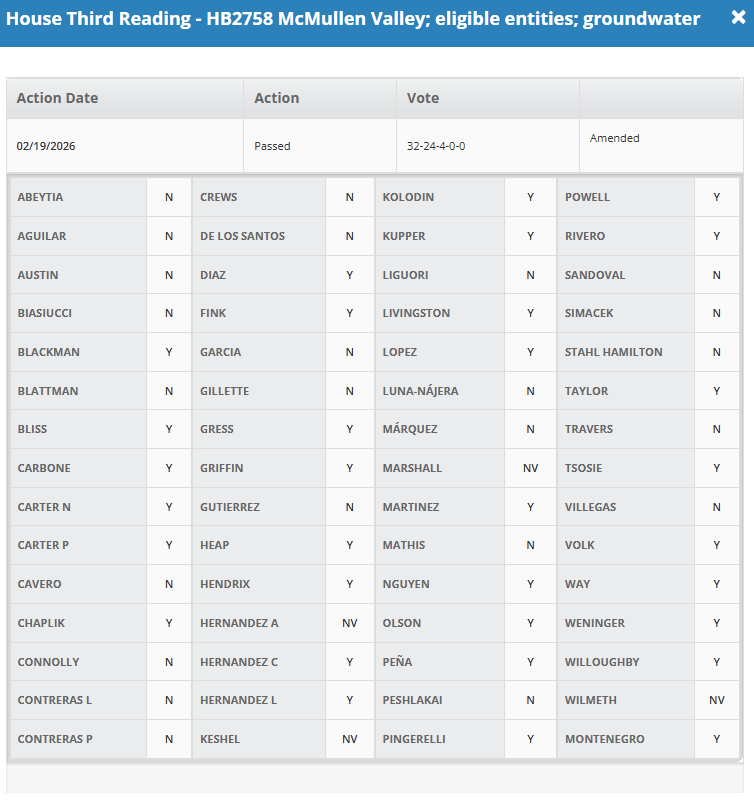
After having failed and then three subsequent readings and various amendments later, HB 2758 allowing WAM to transfer and sell water from McMullen Valley did pass the House. The bill, with amendments passed 32 in favor and 24 nays and 4 abstentions. It passed pretty much along party lines with just a couple of Democrats voting for the bill. Both of our Representatives voted against passage. Below is how each member of the House voted.
What does this mean now?
On the 19th, the bill was transmitted to the AZ Senate. It will now go through the process, and the Senate will vote on the bill. Since pretty much all of the Republicans in the Senate support development of Central AZ rather than rural AZ it is likely to pass the Senate. That means that it will then go to the Governor. WAM, through their lobbyist has stated repeatedly that the Governor will approve the bill as long as there is a plan to “mitigate the damage” caused by WAM transferring water from the Valley. As you all know, there are no such plans at this point so we need to encourage the Governor to veto the bill when it hits her desk.
We will keep monitoring the bill and communicate its process so each member of our community can take the action that they feel is appropriate. You can visit Resources on the website to get addresses and phone numbers of our officials.
Please take the time to subscribe to the site and to Sign our Petition if you oppose this action.
35 years vs 122 years. Who has the heritage and the claim?

Stan Barnes, the founder of Copper Point Consulting, former House leader and the current lobbyist for WAM, asserts that water from McMullen Valley was always meant to support central Arizona’s development, without regard for the growth or survival of rural communities. Legislation from the early 1990s designated several aquifers—including three in La Paz County—as transport aquifers, which have existed for 35 years. Communities such as Wenden and Salome were founded over a century ago, in 1904 and 1905, and it is unlikely their founders anticipated that their water resources would be diverted to urban areas like Phoenix and its suburbs.
Criticizing individuals who purchased land without knowledge of transfer aquifer status, which Mr. Barnes has done in public testimony, is unwarranted and diminishes the foresight of those who established these communities. The question arises: should residents in Buckeye or other metropolitan areas be prioritized over those in rural Arizona regarding water access? There needs to be careful consideration about whether the desert can sustain unchecked growth indefinitely.
Transferring water from McMullen Valley may provide only temporary relief. It is imperative to develop long-term strategies to protect the aquifers throughout the state rather than adopting a policy of planned depletion. Sustainable solutions are required to ensure that rural Arizona’s aquifers are preserved; otherwise, when these water sources are depleted, both rural and metropolitan areas will face significant challenges to continued growth and viability.


