Below are current press articles that have been published about McMullen Valley’s water and the attempt to transfer and sell the water from the basin to Central AZ.
Rural coalition starts campaign to establish groundwater protection zone in McMullen Valley
KJZZ | By Camryn Sanchez
Published August 26, 2026 at 5:35 AM MST

A coalition of Arizonans in the western part of the state are banding together to protect their shrinking groundwater basin by establishing a zone to restrict pumping.
Residents are collecting signatures to establish a groundwater protection zone around the McMullen Valley aquifer.
A New York City based-hedge fund Water Asset Management, LLC, supported legislation earlier this year which would have allowed it to pump some of that water out and sell it to cities in the metro Phoenix area. The bill died, but it spurred locals to take action.
“I just think it’s morally wrong to take water from us that we need for development and survival and send it to Buckeye or wherever so that a family can build a new house and live there. Why are they more important?” McMullen Valley Water Defenders PAC leader Gary Saiter said.
Backers of the protection effort want to put the question of establishing an active management area (AMA) on local ballots next March.
The Arizona Department of Water Resources recently started the process of establishing an AMA in the neighboring Ranegras Plain Basin.
“You know, when the Ranegras Plain AMA got enacted, I did have my constituents out in the McMullen Valley basin asking, ‘You know, what about us? We need protection, too,’” La Paz County Supervisor Holly Irwin said. “So, it’s not with lack of trying, it’s just with the challenges with that basin the people said, ‘We’re not getting the help down at the Legislature, so we’ll try to do it ourselves and take it to the people for a vote.’”
Status of the aquifer
The McMullen Valley aquifer is in rapid groundwater decline.
ADWR compiled a supply and demand assessment of the aquifer in 2023. The report showed that as of 2022, for every 1 acre foot of water in the basin, 5 acre feet was leaving. In other words, the demand far exceeds the supply of groundwater.
A single acre foot is enough water to sustain about three single family homes for one year.
Much of the area surrounding the aquifer is farmland, and only a few thousand people live in the McMullen Valley.
The aquifer encompasses 720 square miles across parts of three counties: La Paz, Maricopa and Yavapai.
The effects of groundwater pumping have already taken a toll, Irwin said.
“Some of us have lost access to water. We see our land is sinking, and one of our schools has a football field that turned to dirt because a well failed,” she wrote in a statement.
The latest in a growing AMA movement
In 1980, four initial AMAs were established through the passing of the 1980 Groundwater Management Act. And a fifth split off of one of those four in 1994.
But from then until 2022, no new AMAs were established. That year, voters in the Douglas area approved a measure to create a new AMA.
Shortly after, Gov. Katie Hobbs’ administration took historic action to establish a new AMA in the Willcox basin.
Then ADWR — under Hobbs’ purview — moved to establish the Ranegras Plain Basin AMA in 2026.
There’s an important distinction between the initial AMAs and the efforts which started in 2022; the new AMAs are rural.
The original AMAs are all established around urban areas and are designed to work that way.
For that reason, lawmakers on both sides of the aisle agree that Arizona should come up with an alternative to AMAs that’s better suited to rural areas. However, Democrats and Republicans haven’t come to an agreement on what that should be.
For now, rural counties are continuing with AMAs as residents become increasingly concerned about groundwater supply.
The first ‘transportation basin’ AMA
The four groundwater basins were set aside as “transportation basins” in 1991.
State law prohibits transferring groundwater from one groundwater basin outside of an AMA into an AMA with the exception of those four transportations, including McMullen Valley.
That means cities like Phoenix and Scottsdale purchased thousands of acres of land in transportation basins years ago, which they can draw from in times of need.
The municipalities have never cashed in on that deal by taking groundwater from McMullen Valley, but that’s what residents fear will soon happen.
The cities of Buckeye and Queen Creek recently started the process of cashing in on the Harquahala Basin — another rural groundwater aquifer and transportation basin.
Arizona State University Kyl Center for Water Policy Director Sarah Porter said that doesn’t necessarily mean the basins will have less groundwater, because farmers in Harquahala will be compensated to let some of their fields fallow to offset the groundwater being taken away.
Just as municipalities drawing on transportation basins may not have any net negative effect on groundwater supply, Porter noted that establishing an AMA in McMullen Valley doesn’t touch its status as a transportation basin.
“Creating an AMA won’t necessarily protect the basin from transportation,” Porter said.

Groundwater supplies in the Colorado River basin are falling fast. Is there a solution?
08:41
June 15, 2026
As the crisis on the Colorado River grows, new pressure to pump groundwater will further stress already-depleted aquifers across the Southwest, according to water managers and scientists studying the ongoing drought.
The decline of groundwater supplies along the Colorado River basin has been accelerating for decades, according to analysis by Arizona State University’s Jay Famiglietti. Most of those losses have come in Arizona.

“We have to be exceptionally careful because it took tens of thousands of years to accumulate, we’re burning through it on a century time scale,” Famiglietti said. “There is essentially no hope of high-magnitude replenishment.”
Because water is heavy, satellites in space can detect the diminished gravitational pull of the water when it’s removed from the ground, he said.
Support WBUR
The added stress on groundwater comes at a time when the supply of surface water is also in decline. The Colorado River, which supplies nearly 40 million people in the West with water, has been teetering on the brink of collapse because of overuse and climate change. A drought fueled by climate change has punished the region for decades.
The seven states that rely on the river are deadlocked over negotiations to share the supply of water, and the federal government is likely to step in and demand significant cuts to their allocations by the end of the summer.
Meanwhile, political fights are escalating in places like Utah, New Mexico and Arizona over the rise of data centers and their impact on water supplies.
“We’re going to come under a lot of pressure as these Colorado River allocations get cut back,” Famiglietti said. “We will have difficult decisions on the horizon.”
Pumping mostly unregulated
In 1980, Arizona passed a groundwater-management law in response to overdrafting from the state’s aquifers. It helps protect water supplies in certain areas, including in big cities like Phoenix and Tucson.
In recent years, those protections have been expanded several times. However, according to Famiglietti’s calculations, only 18% of the state is covered.
In the sprawling suburbs around Phoenix, the Salt River Project utility recharges the aquifer by pumping water from the river over large spreading basins. The water seeps through the sand and gravel soils near the river channel and reaches the aquifer about 200 feet underground.

“Imagine your savings account at your bank,” said SRP’s Sharon Morris, who manages the utility’s groundwater storage system. “In our case, we’re saving it for a not-so-rainy day.”
Morris said SRP has banked about one million acre feet of groundwater at that basin since 1994, which is nearly the equivalent of a large upstream reservoir on the Salt River. The water can be pumped and sent to cities when it’s needed.
Support WBUR
“Imagine what groundwater levels would be if we didn’t have that savings account,” Morris said. “They would be in far worse shape.”
Moving groundwater to thirsty cities
In areas of the state where groundwater is not regulated, the aquifers are not as healthy.
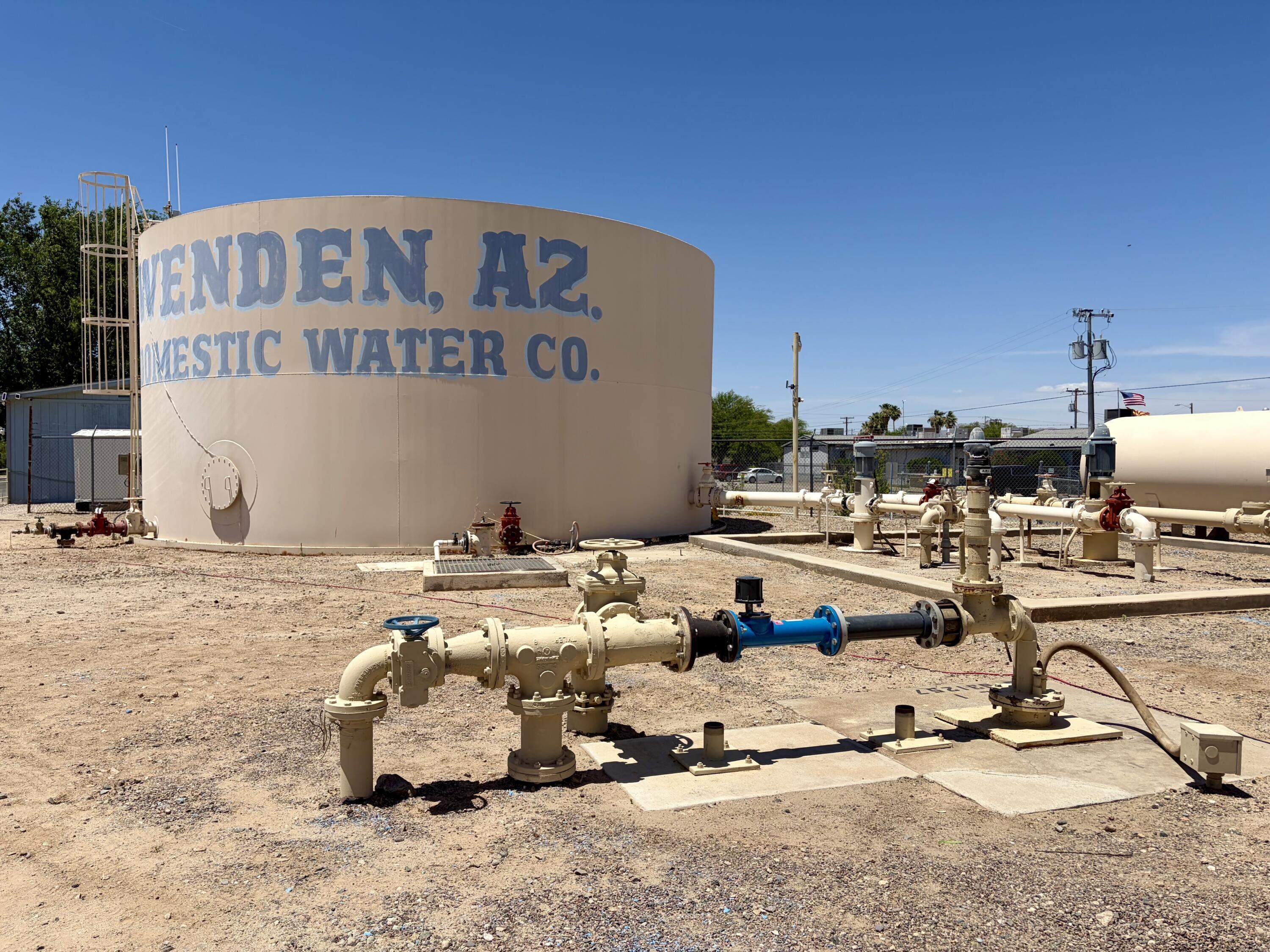
In Wenden, Ariz., about two hours outside of Phoenix, the water table has dropped 18 feet in the past two years, said Gary Saiter, chairman of the Wenden Domestic Water Improvement District.

“It’s steadily gone down over the years, and it’s because of overfarming,” Saiter said.
This desert town is flanked by agriculture. For years, nearby farms have grown crops like pistachios and alfalfa and pumped groundwater without much regard for the aquifer.
The state filed a lawsuit against a Saudi-owned farm operating in La Paz County, alleging it used excessive groundwater to grow alfalfa.
In Wenden, there are signs that the ground is sinking as a result of pumping the aquifer.
Support WBUR
Saiter’s wife, DaVona Saiter, owns the Mas Paz Desert Spirit gift shop, where the floors of her 125-year-old building are slanting downward. Gaps of several inches between the floor and the wall have emerged. A large crack has appeared on the front patio.

“That’s absolutely terrifying to think you can have this natural body — I call it nature’s perfection — that we have altered it to where it is no longer useful,” said DaVona Saiter, referring to the lowered aquifer.
The Saiters have been fighting to stop a bill at the Arizona legislature that would allow private entities to pump water from the McMullan Valley aquifer and sell it to cities like Phoenix and Tucson, arguing it would put the town at further risk for the benefit of major population centers and large corporate landowners.
“I don’t think most of the people in the legislature really care about rural Arizona,” Gary Saiter said.
However, supporters of the groundwater transfer say cities need the water to attract new development and housing, especially because the supply of Colorado River water is likely to face steep cuts.
“If nothing happens, then things continue to get worse,” said Stan Barnes, a lobbyist for Water Asset Management, a New York hedge fund that owns large tracts of farmland in the area.
Barnes told lawmakers earlier this year that the bill would protect the aquifer because it would put a cap on how much groundwater could be pumped. He also said his client was moving away from growing water-intensive crops like alfalfa.
“You can demagogue the New York hedge fund because it feels good. But that’s not what this is about,” Barnes said.
The debate over transferring groundwater from rural areas to cities epitomizes the mounting pressures caused by the persistent drought.
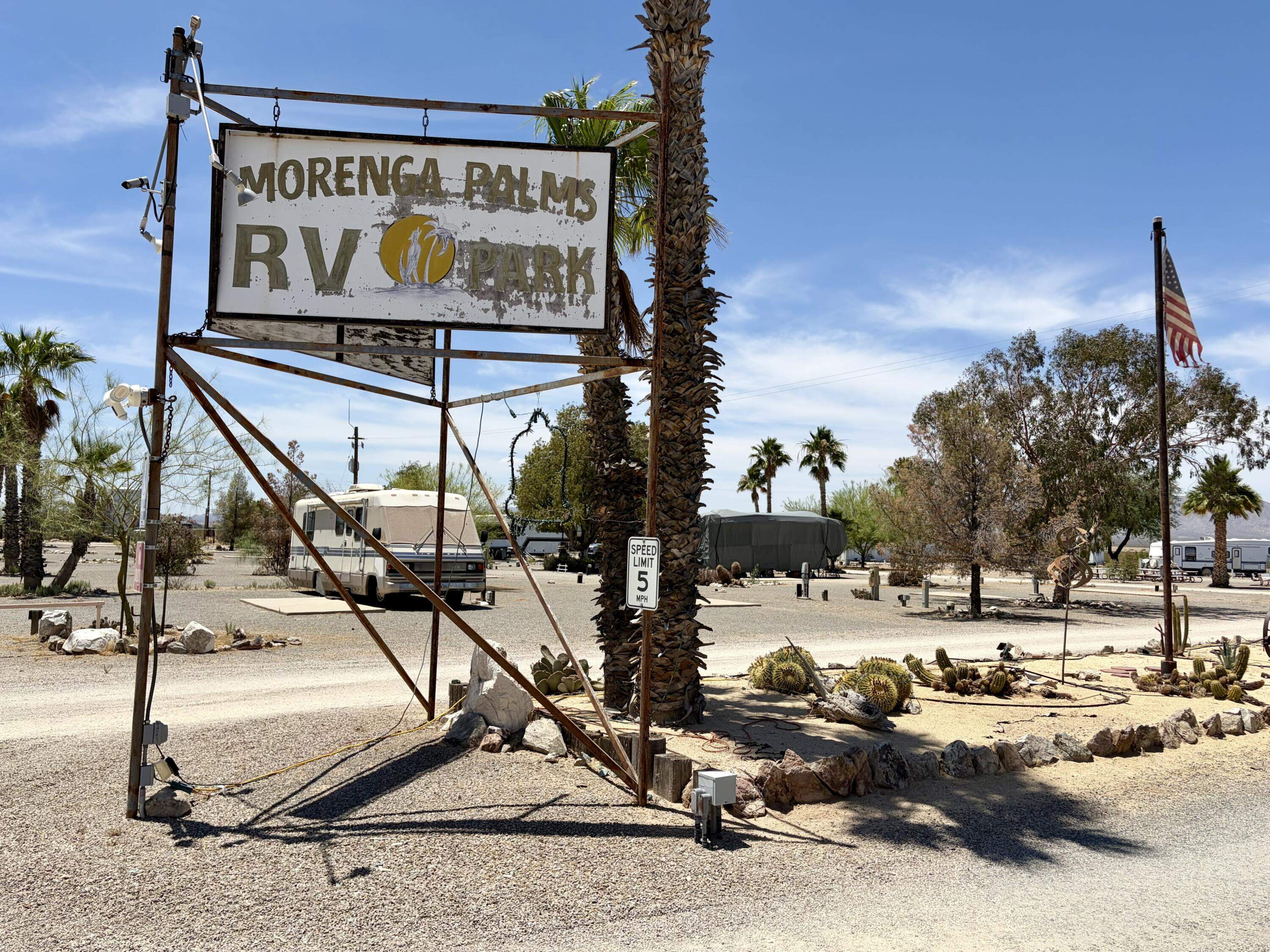
The bill in Arizona would allow pumping of the McMullan Valley aquifer down to 1,200 feet. Rob McDermott’s 600-foot wells at the Morenga Palms RV Park that he runs outside of Wenden went dry a few years ago. He paid $120,000 to dig a new well to 800 feet, and he cannot afford to do it again.
“They’ll just pump this place until it dries up and blows away,” he said.
This segment aired on June 15, 2026. Click here to listen.
Groundwater supplies in the Colorado River basin are falling fast. Is there a solution? | Here & Now
Residents say this Arizona water transfer bill threatens La Paz County’s future
KJZZ | By Mark Brodie
Published March 26, 2026 at 11:46 AM MST
State lawmakers are considering a proposal that would allow a New York-based investment company to sell water from rural La Paz County to more urban parts of the state. The McMullen Valley Basin is what’s known as a “transfer basin,” which allows the water in it to be moved elsewhere.
There are two others, including the Harquahala Basin. Last year, lawmakers approved a bill allowing water to be moved out of that basin.
Phoenix used to own the land in question but sold it in 2012. A few years ago, a firm called Water Asset Management bought it. The company is supporting the bill in the state Legislature.
Stan Barnes is the lobbyist for WAM. He told a Senate committee last week that the company plans to scale back farming water-intensive alfalfa in McMullen, in favor of less thirsty crops. And, he said, if the measure goes through, there’ll be less water being used from McMullen than there has been historically.
“My client is dialing that back and plans to get rid of all alfalfa. Because in spite of it being the money crop for farming, in the end, the water is more valuable some day to move, as needed by the population centers of Phoenix, and Tucson and Pinal County,” Barnes said.
The bill sets limits on how deep the wells could be and how much water WAM could sell to Valley cities. Barnes told lawmakers it’d benefit the roughly 3,000 residents of the area, which includes the communities of Wenden and Salome.
“Local citizens will have a water security they do not have today, because my client has the revenue to spend to make sure they do. And has the political incentive because we know that we cannot get through this process and get a governor’s signature if we don’t do something about the couple of thousand of people who live in the Wenden-Salome area,” Barnes said. “So, for the first time, my client is going to spend millions of dollars and is seeking an agreement with the three main water companies that serve customers there to help prop up their systems, provide financial relief where they need and provide wet water if that’s what they want. We’re going to do more for locals than has ever been done.”
But some of those residents aren’t interested in that, and are urging lawmakers to reject the plan.
Gary Saiter lives in Wenden and serves as chairman of the board for the Domestic Water Improvement District in Wenden. He’s also the board chairman of the Water Alliance for La Paz County. And he’s not a fan of the proposal.
Full conversation
GARY SAITER: Well, in my thinking about this bill, it represents an extreme example of poor planning for the urban areas of this state. Back in the early ’80s, when some of this water legislation was passed, then again in the ’90s when the transport aquifers were created, that was the state essentially taking the rights of rural water residents away, of rural Arizona.
And that meant we no longer had the right to use the water the way that we chose to. And my question has always been, that’s great. When you do that, we sacrifice and we may lose communities and you may survive. But what are you going to do 30 years from now when that water runs out?
BRODIE: So do you see this as sort of kicking the can down the road on the state’s part?
SAITER: Absolutely. And we weren’t too concerned in McMullen Valley because the original bill was written for the city of Phoenix. City of Phoenix, back in the early ’80s, bought 13,000 acres here in the, in McMullen Valley. In 2012, apparently they decided that they no longer wanted to own that for whatever reason that was.
And they sold these 13,000 acres to international Farming out of North Carolina, I believe, and they almost immediately started growing a lot of alfalfa. Some people have said, oh, we’ve grown alfalfa forever. That’s not true.
About two years ago, a company called Water Asset Management, a hedge fund out of New York City, decided to take advantage of the water shortage in Arizona and the laws protecting rural groundwater and purchase those 13,000 acres for $100 million fully with the intent of changing the statute, which hence is House Bill 2758, so that they would be allowed to transfer water. We weren’t really concerned about it before because it was written for Phoenix. Now with this change, now we’re in, we’re being threatened.
BRODIE: What do those threats look like? You alluded to maybe communities going away. Like, is that a realistic possibility?
SAITER: Absolutely. The average well depth in McMullen Valley is 572 feet, according to ADWR. And we use more water than we should. This, this aquifer is in a deficit, but WAM continues to tell us that, you know, it’s going to be OK and they’re going to slow down the water usage. But if you look at the math, there’s no way for them to do that unless they eliminate agricultural activities completely, which is a whole other problem.
They have the right to take up to 33,000 acre-feet per year from the aquifer, in addition to the 59,000 acre-feet that … we already use in the valley for agriculture. And a tiny, tiny portion for people. And they have the right to take the aquifer down to 1,200 feet. At 1,200 feet, it’s incredibly expensive to drill wells low enough to be able to access that water. And it’s incredibly expensive from an electric, from the cost of electric to actually withdraw that water from the aquifer at that depth.
So that puts the 800 people in the valley that rely on private wells, their wells would be dry in eight to 10 years, and the aquifer itself will be at 1,200 feet in about 35, 36 years. And then heavy, hard decisions have to be made by people as to whether they’re going to stay, figure out some way to get water, which would be incredibly difficult, or just go.
BRODIE: Well, you live in that area. What would you do?
SAITER: I’d probably move.
BRODIE: So one of the arguments that Water Asset Management is making, and you kind of alluded to this, in the sense that you know your area is using more groundwater than maybe it should. One of their arguments is that this would lead to less groundwater depletion, that the aquifer would be in better condition if they were taking the amount of water they plan to take out of it than what’s currently being taken out of it. What do you make of that argument?
SAITER: I’ve been asking them for two years for information to back that up. And the simple math is that unless they eliminate all agricultural use, there’s no mathematical way to achieve that.
BRODIE: I’m curious also what you make of some of the, I guess what supporters of this bill are calling protections for residents of the McMullin Valley in terms of how much water they can take and the limits on how deep they can go and that sort of thing. Based on your chuckling, it sounds like you don’t really think much of them.
SAITER: Well, I don’t think much of them at all because, hey, we’re going to, we’re going to take your water, but we’re going to protect you and we’re going to give you more water. Gail Griffin specifically has several bills that she says will take care of us in the Valley. They don’t.
My concern is that when House Bill 2758 passes, if it does, then we have no leverage any longer to negotiate anything in terms of them taking care of our long term needs.
BRODIE: Is there something about the fact that the company that is involved in this is a hedge fund, it’s based in New York City? You referenced how the city of Phoenix used to own this land. Would it be different in some way if it wasn’t a New York-based hedge fund that was doing this, if it was some other entity, or maybe even an Arizona-based entity?
SAITER: Not in my mind. Years ago, five years, six years ago, whatever it was, everybody’s hair was on fire about the Saudis stealing all of our water, growing alfalfa and turning into hay and shipping it to the Middle East. Well, the Saudis did nothing illegal. They were taking advantage of the laxity of groundwater regulations in rural Arizona.
So they weren’t the bad guy. The bad guy was the Legislature. I put WAM in that same position. They’re simply taking advantage of the laws that we have managing groundwater in rural Arizona to make money. I can’t really blame them for that. I can’t say they’re the enemy. It could be anyone coming in and buying the land and being able to do the same thing.
The problem is inaction by the Legislature and not moving to protect the groundwater. You know, you have to ask the question, why is a family of four who wants to buy a new home in Buckeye or wherever it happens to be, why are their rights more important than mine? And I have to sacrifice my water and potentially lose my community just so you can live there?
Click here to hear the story:
Residents say this Arizona water transfer bill threatens La Paz County’s future

Water exports make Salome, Arizona, residents worry about community

Arizona Republic
Updated March 27, 2026, 9:11 a.m. MT
SALOME — It didn’t take long for Kristie Starzak-Stanton and her husband Scott Stanton to decide this quiet desert town is where they’d like to make home and retire. But just two years after putting money into a small guesthouse, they are wondering if it will be a good investment in the long run.
State lawmakers are deciding whether to allow a water investor to sell groundwater below Wenden and Salome to metro Phoenix, Pinal County and Tucson. The Ohio couple didn’t think that much about water until moving to Arizona, but now fear they’ll be at risk of not having enough and question why the area was tagged for a transfer plan.
“My concern is: Why are they tapping into these areas that actually have small communities that need water?” asked Stazark-Stanton. “Are we not important enough?”

A law signed in 1991 allows transfers from that area, but it needs important tweaks so Water Asset Management, a New York-based company that owns farmland in Wenden, can make it effective.
The Republic visited a dozen residents in Salome and Wenden to hear their views on the transfer plan and the future of the community. All saw the towns as their last home and would like to see some growth and new conveniences, but some were divided on how the water transfer fits those plans.
Jim Downing, the long-time manager of the McMullen Valley district providing power to agricultural operations, was involved in advising the first water transfer law in the late 1980s. The water in their valley, he said at a hearing on March 17, “was destined for the Phoenix AMA as soon as the ink dried on the 1980 Groundwater Law.”
In his view, the deal with Water Asset Management is “the best solution” residents will get, and said the company is very close to signing a contract with one Salome utility to finance better infrastructure. The company would also pay off a debt the utility owes to Downing’s irrigation district. He declined to give an interview to The Republic
So, Mr. Downing was involved with the original legislation that got us here. He knew our water would be sacrificed for Central AZ and now he is deep into a compromise to solve the problem that he helped create.
Water Asset Management says that with the transfer there will be less water going out of the aquifer than if alfalfa farming continued, and that the company will invest in water infrastructure for locals. There’s nothing in the bill concerning this commitment. Hundreds of acres of alfalfa have been converted to a hardy type of yucca from the Hesperaloe genus.
“The project can keep agricultural activity on the land surface with low water use crops, can support water flowing to local citizens, and can fulfill the promise made over 35 years ago to the population centers of central Arizona,” said Stan Barnes, a lobbyist representing the hedge fund, who was instrumental in passing the 1991 transfer law.
Gary Saiter, the chairman of the Wenden Domestic Water Improvement District board, serving some 450 people, says the math doesn’t add up and he hasn’t seen a serious plan to protect locals’ water future in the long run. Saiter has received no inquiry from the company about the utility needs, nor received a plan, he told The Republic.
He has been a vocal opponent of the water transfer bill, House Bill 2758, and testified at House and Senate committee hearings; “I don’t understand why a family in Buckeye in a four-bedroom home is more important and more valuable than me,” he told The Republic.
Bill awaits a vote in the state Senate
Melissa Smith, owner of a deli, grocery shop and motel in Salome and an involved community member, said she hasn’t heard a real plan from the New York company to secure locals’ water future and doesn’t see how the water situation could improve with the drought. Cities should limit their growth, use their own resources or manage them better.
“We don’t have enough water to just pump it off to the big cities,” Smith said.
Under the proposed law, the company would be allowed to pump groundwater up to a depth of 1,200 feet from the 13,000 acres of farmland their subsidiary purchased in 2024.
If all the property meets eligibility criteria, the company could sell and transfer an allotted volume of 39,000 acre-feet of water a year. However, the proposed law allows it to go two times over annual allotments, up to a total of 6 acre-feet of water per acre of farmland — alfalfa farms with sub-surface drip irrigation use about 4.5 acre-feet of water a year.

| The bill also says the company can’t transport more than 6 million acre-feet of water in total. There are no groundwater models to say for certain how much water is available in the aquifer. Documents used for planning purposes estimate there are about 1.3 million acre-feet of water at depth of 573 feet, the average well depth in the basin, but the department discourages using this as scientific evidence. | To put this is perspective, 6-million-acre feet would supply the water needs of McMullen Valley for 101 years. WAM themselves feel that they have 3-million-acre feet to deal with until they hit the 1,200 level, which is as low as they can go. So essentially the bill, which is to protect McMullen Valley, does nothing for us. |
The bill passed the Senate committee among party lines and if the full Senate approves it, the measure will head to Gov. Katie Hobbs’ desk.
“It’s clear that the communities in that basin don’t want to have their future pumped away from them,” Patrick Adams, senior advisor of water policy to Hobbs, told The Republic. It also became clear the proponents of the transfer acknowledge they need a mitigation plan.
“We have not seen any concrete evidence of a plan that would address the concerns of the community.”
Regardless of the future of the bill, the company will support one of the three local utilities, Salome Water Company, by drilling a new well, installing a pipeline, and paying off the debt to the irrigation district. If the bill becomes law, Barnes wrote, the transfer project will develop a plan to connect the three utilities to “deeper portions of the aquifer located beneath the project farm.”
The company would also design “local water infrastructure” with a 100-year horizon in sight, made to support existing users, future population growth, line extensions to connect resident’s on private wells to the water system and water hauling services.
“The project understands the need to memorialize these binding commitments and is exploring appropriate methods to do so,” Barnes wrote to The Republic.
Is the water transfer a wealth transfer?
Combined, the towns of Wenden and Salome have about 1,140 residents, according to the latest census data; that population nearly doubles in the winter, according to some locals’ estimates. There are also two airparks, a couple of coffee shops, restaurants, bars and several RV parks.
One water utility serves Wenden and two serve Salome, but many residents and business depend on private wells. Saiter, chairman of the Wenden utility, said they had to deepen their well to 1,500 feet and increase repairs due to subsidence — satellite data shows land sinking in the valley is among the greatest in the state. The utility has received state and federal funds for repairs and water treatment. It’s a cost individuals can’t easily cover upfront.
Rob McDermott, a mobile home park owner in Wenden, had to re-drill an 800-foot well at a cost of $120,000 to keep operating. Several businesses rely entirely on hauled water now, he told The Republic last year.
The owner of Amber Hills Complex in Salome, Melissa Smith, used to live next to one of the alfalfa fields in Wenden but decided recently to move out of her home and into a new property because the water quality got so bad she couldn’t drink it or brush her teeth due to the high level of nitrates and salts. Her former neighbors had to punch a new well. She knew her 300-foot well could never compete with the farms, she said.
Smith moved eight years ago from the northwest to be close to family and have a calmer life. She began running a local gas station and in 2023 opened her own business. To the deli, grocery store and motel, she added a lot with storage units and is also eyeing property to start a daycare and fitness center.
“I’m here for the community,” Smith said. “I believe if you support your community, your community will support you.”
She prefers to keep her opinions to herself about other controversial projects in the area, but says water is different.
“I’m trying to create some necessities for this town and water is a huge deal. It’s talked about all the time,” she said. The water transfer is in a way a wealth transfer, she suggested.
“I don’t like the fact that they’re coming in to take our water from farmland and where we are raising our cattle, and the big city just wants to come and take water from us.”
Did alfalfa exports affect other agricultural development?
Groundwater declines have been a constant in the history of the McMullen Valley, an area with low recharge from rainfall and a long agricultural history.
During the 1960s there were many vegetable, melon and cotton farms near Wenden. These crops required more labor than the current alfalfa fields and employed seasonal and permanent farmworkers who injected life into the small town’s economy.
The family of Wenden shop owner DeVona Saiter, whose maiden name is Ramirez, was part of this early history. Her grandad moved with his family from northern Mexico to Wenden and worked on a cotton gin until retirement. To this day, the town is full of relatives and long-timers, she said, cousins, aunts, uncles and grandchildren with last names like Perez, Palma and Jordan.
Saiter doesn’t recall any talk from relatives when lawmakers passed the first water transfer law in 1991. “They were busy trying to make a living and feed their family.” But to her what matters is what happens going forward, she said.
In the 1980s, Phoenix bought farmland with the intention of a future transfer but sold it to investment firm International Farming Corporation in 2012. Then came United Arab Emirates Al-Dahra, leasing from IFC, and in 2024 Water Asset Management bought the 13,000 acres.
The export of alfalfa by foreign companies, the water investors and the calls of many locals for groundwater protections placed La Paz County in the news spotlight for the last decade.
Some residents believe all this attention has blown the water issue out of proportion and driven away investment, but like those who have been loud at advocating for state action, they want the community to thrive.
The desert valley and warm winters have not only attracted RV retirees but also people from the Rocky Mountain states who come to team rope and ride horses. They buy and develop properties because they’re close to Wickenburg, famed as the team roping capital of the world.
A lot of that investment has gone away with the fears of water access due to “bad press,” said Troy Scott, the former owner and utility manager of Salome’s Harrisburg Water Co.

| The water table is continuing to drop and the aquifer is not replenishing fast enough, but agricultural water use is not as bad as it used to be, he said. Before the 1990s, vegetable and cotton farmers were flood irrigating and long-time ranchers and well drillers recall water level declines as high as 8 feet a year. When alfalfa became the dominant crop, that land was converted to subsurface drip irrigation. Managing the utility, Scott saw water level declines of 3 feet a year. Cactus State Utility, the current owner of Harrisburg Water Co., wrote to The Republic “the depth to groundwater has been stable.” | Water levels across an aquifer are not always consistent with different readings at different places. The true measurement is the amount of decline. Wenden Water has taken readings on their wells for decades and the readings in Wenden are quite different than they are according to Cactus Water. Over the past two years the water levels under Wenden have fallen 16ft. |
Groundwater recharge and depletion vary greatly depending on where wells are located. Below ground, the aquifer characteristics and proportion of sediments like gravel or clays affect well productivity; water does not move around the same way across the valley, which makes for uneven water level declines.
For Scott, the tragedy is that the blame placed on Middle Eastern farms and the portrayal of a “water crisis” pushed away an agricultural economy and new local businesses, but opened the doors to the water investors. That, in his view, will be the real problem. It felt like a set up, he said; “I don’t care how you look at it. The water was leaving.”
He agreed with Democrats about blocking water from leaving the valley, but sees the transfer as a done deal. Water Asset Management called 20 locals into a meeting to inform them of the plan. Scott said they never gave “real answers” on how they’d mitigate the damage.
“When there is a real desperate need they will start sending the water to Buckeye,” Scott said, adding that may not happen until a decade or more, but that the water table in some areas would go down “dramatically.”
“People that are on (private) wells are definitely have to start deepening,” he said.
Winter visitors’ chosen home
Kristie Starzak-Stanton and Scott Stanton purchased Salome’s Westward Inn two years ago, a four-room boutique motel with a lush front yard and welcoming adobe walls. The couple came into La Paz County three years ago while they were traveling west, leaving behind their jobs and house in Ohio.
The KOA campground in town was their first stop, and they decided to winter there. Two months in, Scott got a job managing the property and they looked for opportunities to grow roots and buy property.
“This is home now,” said Scott. He rocked his chair with a grin under the shade of a ramada, wind chimes in the back. “We’re not going anywhere. I’m not transient.”
Hundreds of other residents have placed bets on Wenden and Salome for their retirement or a career and lifestyle transition away from the big cities. A neighbor of Rhonda Tipton, an artist who moved from Houston with her husband five years ago to set roots in Wenden, called it “their last dance.”
Tipton doesn’t want to move again but is concerned their private well will be at risk of going dry, “It’s like I was always meant to be here,” she said of the desert and welcoming community they’ve found.
Winter visitors’ chosen home
Kristie Starzak-Stanton and Scott Stanton purchased Salome’s Westward Inn two years ago, a four-room boutique motel with a lush front yard and welcoming adobe walls. The couple came into La Paz County three years ago while they were traveling west, leaving behind their jobs and house in Ohio.
The KOA campground in town was their first stop, and they decided to winter there. Two months in, Scott got a job managing the property and they looked for opportunities to grow roots and buy property.
“This is home now,” said Scott. He rocked his chair with a grin under the shade of a ramada, wind chimes in the back. “We’re not going anywhere. I’m not transient.”
Hundreds of other residents have placed bets on Wenden and Salome for their retirement or a career and lifestyle transition away from the big cities. A neighbor of Rhonda Tipton, an artist who moved from Houston with her husband five years ago to set roots in Wenden, called it “their last dance.”
Tipton doesn’t want to move again but is concerned their private well will be at risk of going dry, “It’s like I was always meant to be here,” she said of the desert and welcoming community they’ve found.
‘A diamond’ of sunshine and affordability
There are other investors trying to put roots in the McMullen Valley.
Philip Roxworthy, native from Chicago and a “foodie” working in the retail and restaurant business for years, scoped properties across the country and chose Wenden for affordability, sunshine and water. He was pointed toward the area by realtor friends marketing agricultural properties in La Paz County.
He bought a 30,000-acre cattle ranch in Wenden in 2019 with friends and wants to farm hemp, something he did in southern Oregon. The plan is to also build a luxury RV resort with an organic ranch and farm to offer local food to guests. He also owns a saloon on the corner of Alamo Lake Road and Highway 60 and plans to buy the grocery store next door and turn it into a butcher shop and deli, to be supplied by a ranching partner with a meat processing plant.
Some of the state land that Roxworthy planned on ranching was taken away for a solar energy project that has been highly controversial between neighbors. There is a transfer station for the main power lines nearby and a plan to build a natural gas facility. BrightNight, the company behind the Eagle Eye project, has held public meetings for a couple of years. The next one is March 24.
As a “political junkie” with a family running on opposite party sides, Roxworthy said he has found common ground when discussing food.
“We all understand how broken our food system is, from our sourcing to our table,” he said. Wenden is a food desert where locals can’t buy fresh produce nearby, but it has some of the best conditions to become an agriculture power if it moves away from water-intensive crops and gains some kind of water management, he said.
“This area is a diamond because of the fact it can grow four seasons a year with its own water,” Roxworthy said, adding he wouldn’t like to see the valley lose one of the more precious resources to profit-driven water transfers.
“It’s beyond the immediacy issue,” he said. “It’s that there is no plan to bring economic viability to this entire area. You take the water out of here; it’s never going to come back and then this place doesn’t have a future.”
Clara Migoya covers agriculture and water issues for The Arizona Republic and azcentral. Send tips or questions to clara.migoya@arizonarepublic.com.

Residents say this Arizona water transfer bill threatens La Paz County’s future
March 26, 2026
State lawmakers are considering a proposal that would allow a New York-based investment company to sell water from rural La Paz County to more urban parts of the state. The McMullen Valley Basin is what’s known as a “transfer basin,” which allows the water in it to be moved elsewhere.
There are two others, including the Harquahala Basin. Last year, lawmakers approved a bill allowing water to be moved out of that basin.
Phoenix used to own the land in question but sold it in 2012. A few years ago, a firm called Water Asset Management bought it. The company is supporting the bill in the state Legislature.
Stan Barnes is the lobbyist for WAM. He told a Senate committee last week that the company plans to scale back farming water-intensive alfalfa in McMullen, in favor of less thirsty crops. And, he said, if the measure goes through, there’ll be less water being used from McMullen than there has been historically.
“My client is dialing that back and plans to get rid of all alfalfa. Because in spite of it being the money crop for farming, in the end, the water is more valuable some day to move, as needed by the population centers of Phoenix, and Tucson and Pinal County,” Barnes said.
The bill sets limits on how deep the wells could be and how much water WAM could sell to Valley cities. Barnes told lawmakers it’d benefit the roughly 3,000 residents of the area, which includes the communities of Wenden and Salome.
“Local citizens will have a water security they do not have today, because my client has the revenue to spend to make sure they do. And has the political incentive because we know that we cannot get through this process and get a governor’s signature if we don’t do something about the couple of thousand of people who live in the Wenden-Salome area,” Barnes said. “So, for the first time, my client is going to spend millions of dollars and is seeking an agreement with the three main water companies that serve customers there to help prop up their systems, provide financial relief where they need and provide wet water if that’s what they want. We’re going to do more for locals than has ever been done.”
But some of those residents aren’t interested in that, and are urging lawmakers to reject the plan.
Gary Saiter lives in Wenden and serves as chairman of the board for the Domestic Water Improvement District in Wenden. He’s also the board chairman of the Water Alliance for La Paz County. And he’s not a fan of the proposal.
Full conversation
GARY SAITER: Well, in my thinking about this bill, it represents an extreme example of poor planning for the urban areas of this state. Back in the early ’80s, when some of this water legislation was passed, then again in the ’90s when the transport aquifers were created, that was the state essentially taking the rights of rural water residents away, of rural Arizona.
And that meant we no longer had the right to use the water the way that we chose to. And my question has always been, that’s great. When you do that, we sacrifice and we may lose communities and you may survive. But what are you going to do 30 years from now when that water runs out?
BRODIE: So do you see this as sort of kicking the can down the road on the state’s part?
SAITER: Absolutely. And we weren’t too concerned in McMullen Valley because the original bill was written for the city of Phoenix. City of Phoenix, back in the early ’80s, bought 13,000 acres here in the, in McMullen Valley. In 2012, apparently they decided that they no longer wanted to own that for whatever reason that was.
And they sold these 13,000 acres to international Farming out of North Carolina, I believe, and they almost immediately started growing a lot of alfalfa. Some people have said, oh, we’ve grown alfalfa forever. That’s not true.
About two years ago, a company called Water Asset Management, a hedge fund out of New York City, decided to take advantage of the water shortage in Arizona and the laws protecting rural groundwater and purchase those 13,000 acres for $100 million fully with the intent of changing the statute, which hence is House Bill 2758, so that they would be allowed to transfer water. We weren’t really concerned about it before because it was written for Phoenix. Now with this change, now we’re in, we’re being threatened.
BRODIE: What do those threats look like? You alluded to maybe communities going away. Like, is that a realistic possibility?
SAITER: Absolutely. The average well depth in McMullen Valley is 572 feet, according to ADWR. And we use more water than we should. This, this aquifer is in a deficit, but WAM continues to tell us that, you know, it’s going to be OK and they’re going to slow down the water usage. But if you look at the math, there’s no way for them to do that unless they eliminate agricultural activities completely, which is a whole other problem.
They have the right to take up to 33,000 acre-feet per year from the aquifer, in addition to the 59,000 acre-feet that … we already use in the valley for agriculture. And a tiny, tiny portion for people. And they have the right to take the aquifer down to 1,200 feet. At 1,200 feet, it’s incredibly expensive to drill wells low enough to be able to access that water. And it’s incredibly expensive from an electric, from the cost of electric to actually withdraw that water from the aquifer at that depth.
So that puts the 800 people in the valley that rely on private wells, their wells would be dry in eight to 10 years, and the aquifer itself will be at 1,200 feet in about 35, 36 years. And then heavy, hard decisions have to be made by people as to whether they’re going to stay, figure out some way to get water, which would be incredibly difficult, or just go.
BRODIE: Well, you live in that area. What would you do?
SAITER: I’d probably move.
BRODIE: So one of the arguments that Water Asset Management is making, and you kind of alluded to this, in the sense that you know your area is using more groundwater than maybe it should. One of their arguments is that this would lead to less groundwater depletion, that the aquifer would be in better condition if they were taking the amount of water they plan to take out of it than what’s currently being taken out of it. What do you make of that argument?
SAITER: I’ve been asking them for two years for information to back that up. And the simple math is that unless they eliminate all agricultural use, there’s no mathematical way to achieve that.
BRODIE: I’m curious also what you make of some of the, I guess what supporters of this bill are calling protections for residents of the McMullin Valley in terms of how much water they can take and the limits on how deep they can go and that sort of thing. Based on your chuckling, it sounds like you don’t really think much of them.
SAITER: Well, I don’t think much of them at all because, hey, we’re going to, we’re going to take your water, but we’re going to protect you and we’re going to give you more water. Gail Griffin specifically has several bills that she says will take care of us in the Valley. They don’t.
My concern is that when House Bill 2758 passes, if it does, then we have no leverage any longer to negotiate anything in terms of them taking care of our long term needs.
BRODIE: Is there something about the fact that the company that is involved in this is a hedge fund, it’s based in New York City? You referenced how the city of Phoenix used to own this land. Would it be different in some way if it wasn’t a New York-based hedge fund that was doing this, if it was some other entity, or maybe even an Arizona-based entity?
SAITER: Not in my mind. Years ago, five years, six years ago, whatever it was, everybody’s hair was on fire about the Saudis stealing all of our water, growing alfalfa and turning into hay and shipping it to the Middle East. Well, the Saudis did nothing illegal. They were taking advantage of the laxity of groundwater regulations in rural Arizona.
So they weren’t the bad guy. The bad guy was the Legislature. I put WAM in that same position. They’re simply taking advantage of the laws that we have managing groundwater in rural Arizona to make money. I can’t really blame them for that. I can’t say they’re the enemy. It could be anyone coming in and buying the land and being able to do the same thing.
The problem is inaction by the Legislature and not moving to protect the groundwater. You know, you have to ask the question, why is a family of four who wants to buy a new home in Buckeye or wherever it happens to be, why are their rights more important than mine? And I have to sacrifice my water and potentially lose my community just so you can live there?

The New Republic
March 17, 2026
Thirst Trap
The American West Is Drying Up. Can the Market Help?
As hedge funds buy up land to obtain water rights, a libertarian state representative from Arizona has proposed a seemingly radical solution to the water crisis. Is he right?
When members of the Colorado River Water Users Association, or CRWUA, descended on Caesars Palace for their annual conference in December, few showed much enthusiasm for Las Vegas’s popular diversions. Attendees mostly bypassed the slots and roulette tables, the magic shows and nightclubs. The sole planned excursion on offer—an early morning jaunt to Hoover Dam—was the definition of a busman’s holiday. This was not a decadent bunch. They were serious-minded people dealing with a monumental problem. Some called it an emergency; even the most sanguine considered it a crisis.
The CRWUA conference is always in Vegas. Water wonks have been making the pilgrimage since 1945, when the Strip was still known as Highway 91 and Elvis was playing dairy shows back in Tupelo. The city’s transformation, for better or worse, was as much their predecessors’ doing as it was gambling kingpin Meyer Lansky’s. They’d subdued the mighty Colorado River, channeling its waters—along with the megawatts of power they generated—to build not only Sin City but Los Angeles, San Diego, Phoenix, Tucson, and as much as 15 percent of the United States agriculture sector. It was not cowboys or pioneers but federal water engineers who birthed the West as we know it, “a culture and society built on … a sharply alienating, intensely managerial relationship with nature,” as historian Donald Worster put it.
This year’s meeting drew 1,700 or so attendees. Along with policy experts, hydrologists, commissioners, and environmentalists were many of the stakeholders—the property developers, agribusiness executives, tribal representatives, and so on—whose livelihoods, and in some cases lives, depend on the dwindling and beleaguered waterway. The pilgrims hailed mostly from seven Western states, divided a century ago into competing factions: the Upper Basin (Colorado, Wyoming, New Mexico, Utah) and the Lower Basin (Nevada, Arizona, California). They talked flow, irrigation, conservation, and, in more somber moments, seepage, evaporation, bathtub rings, and dead pools.
A week before the conference, local news stations aired a story about a man in Laughlin, a 90-minute drive to the south, who’d literally walked across the river and back while a drone hovered overhead, memorializing the escapade. The amusing human interest story had a forbidding subtext: The Colorado was drying up, thanks in part to the West’s 26-year-long “megadrought”—its worst in 1,200 years—which many scientists believe may be permanent.
The science isn’t complicated, but these days it bears repeating. Due to a warming atmosphere, snow lines in the Rockies and other ranges flanking the river are in retreat, meaning less spring snowmelt trickling into the basin, even as increasingly parched earth and warm air claim their share of the remaining moisture. As a result, the river’s 46 reservoirs, including the enormous man-made Lake Powell and Lake Mead, now stand more than two-thirds empty, according to a recent report by the Colorado River Research Group. A few more dry years coupled with continued overconsumption, the report suggests, could plunge Lake Mead into “dead pool” status, when levels fall so low that hydroelectric power (already running at a reduced capacity) flickers out and water no longer reaches the outlet works that channel it downriver.
As Matt Diserio, co-founder and president of Water Asset Management, a hedge fund that has spent millions buying land in the area (principally for the attached water rights), noted last year in an investor pitch, “It’s underreported just how severe and near-cataclysmic these risks are.”
How bad could it get? In late January, the United Nations released a report declaring the advent of what it called global “water bankruptcy”: a catastrophic new normal. The new terminology would seem to suggest a long-shot gamble that the language of financial insolvency might somehow spur action among leaders who have grown numb or even hostile to more sciencey admonitions.
One can hope. As the report states, “available water resources … have been significantly reduced, with some impacts … effectively irreversible on human time scales.” (Damn those human time scales.) The authors found the most severe threats in the Middle East, North Africa, South Asia, and, yes, parts of the U.S. Southwest. Similar forecasts are outlined in a study by South Korean researchers published in September in Nature Communications. Under high-warming scenarios, the authors determined, both Phoenix and San Diego will be among the areas where extreme, multiyear water scarcity—what the authors term “Day Zero Drought”—is projected to emerge within the coming decade.
Although Chennai, Cape Town, São Paolo, Mexico City, Kabul, and Tehran, among other localities, have already flirted with similarly apocalyptic circumstances, for the crowd at Caesars, such nightmares seemed remote. “We are not running out of water,” said Rhett Larson, professor of water law at Arizona State University and one of the conference’s keynote speakers. “We are running out of cheap water.”.

The New York–based hedge fund Water Asset Management was co-founded by (from left) Disque Deane Jr., Matt Diserio, and Marc Robert. The fund has spent millions buying up land in the West, principally to secure the attached water rights.
Indeed, to many observers, the substance has been greatly undervalued for decades. Water used for irrigation—which in Arizona accounts for more than 70 percent of the state’s total usage—is had for a tiny fraction of its real cost. This enormous subsidy has encouraged many commercial ag firms to plant thirsty crops like cotton and alfalfa, much of it for export. Meanwhile, Arizona remains one of the fastest-growing states in the country, and property developers are eager to see that water directed toward new housing. As a result, a handful of speculators have stepped in, buying up farmland in hopes of channeling its water toward more urban areas for a tidy profit.
Amid this ongoing tussle, a few lonely voices, including a right-wing Arizona state representative named Alexander Kolodin, have been proposing a seemingly radical solution: What if we just … gulp … let the market decide?
To the extent that the CRWUA conference boasted anything close to a celebrity attendee, the honor belonged to Bruce Babbitt, the former governor of Arizona and later secretary of the interior. In between posing for selfies with fans, the fit 87-year-old weighed in on the dire state of affairs. The basin states would soon “be operating on what they call ‘run of the river,’” he told me. “We’ve been putting off the crisis by using the storage in these giant reservoirs of Glen Canyon and Hoover. There’s about a year left before there’ll be structural problems in Glen Canyon. There’ll be dead pool, probably, in Hoover Dam. So we really are at the decision point.”
Indeed, a political crisis quietly loomed over the conference. The Colorado River Compact, an agreement hammered out in 1922, had bestowed upon the Upper and Lower Basins an annual 7.5 million acre-feet of water apiece—a surging, rippling bounty that simply no longer exists, if in fact it ever did. Last updated in 2007, the compact was again up for renewal, and some tough-to-swallow compromises would be required.
The tug-of-war pitted the states of the Lower Basin, which for decades made eager use of their allotment—with the impressive population growth, agricultural output, and economic spoils to show for it—against their slower-to-develop and historically less needful neighbors to the north. While the Lower Basin states have cut back sharply and have agreed to shoulder the largest future reductions, they’re pressing the Upper Basin to chip in as the deficits grow. Meanwhile, the Upper Basin states, which never made full use of their entitlements, have clung fiercely to their water rights and the chance at future economic growth they represent. As in 1922, no representatives from the 30 or so Native American tribes who call the area home (and hold some of the most senior water rights, if not the infrastructure to exploit them), or from Mexico, which is also entitled to a portion of the Colorado’s flow, have been party to the negotiation.
State water commissioners had already blown one deadline when, on the conference’s final morning, they took the stage in the packed Augustus Ballroom for an event that felt like a cross between a high-level summit and a hostage video. Most attendees had already checked out of their hotel rooms—their wheeled suitcases lined the periphery of the space—but few dared skip this top-of-the-card reckoning.
Seated at a long dais draped with gold skirting, flags hanging behind them, the commissioners mostly stuck to their talking points. They trumpeted their states’ respective conservation efforts, highlighted the pain already felt by their various constituencies, demanded more flexibility from their opponents, and invoked the implacable power of Mother Nature to force a reckoning one way or another. (In other words, the house always wins.) Aside from a swaggering opener by California Commissioner JB Hamby (“California is here to save the Colorado River,” he began), the only real drama concerned the matter of whether Colorado Commissioner Becky Mitchell—recently dinged in the New York Times op-ed pages for her alleged recalcitrance—would become teary-eyed as she sometimes does during such appearances. Her voice cracked a bit, but the dam held fast.
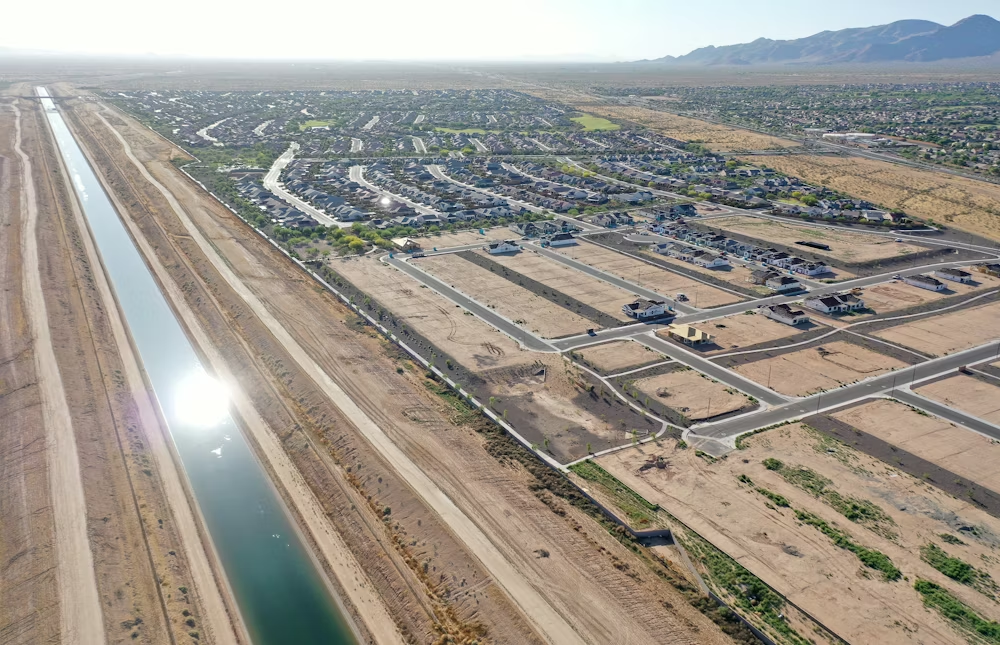
The town of Buckeye, a fast-growing municipality west of Phoenix, purchased a single acre of land in the basin for $80 million, which will entitle it to nearly 6,000 acre-feet of water per year—enough to more than double its current population of 125,000.
The conference adjourned with no sign of progress. An extended deadline had been set for February 14, and late January would find the commissioners and their respective governors summoned to Washington for a skull-cracking session with Interior Secretary Doug Burgum. But no one I spoke to seemed to think the states would come to terms—not until the legal complaints started flying. “You can see the need for broad compromise,” observed John Fleck, an expert in water policy with the University of New Mexico Department of Economics. But the commissioners then “have to go back home and sell that compromise to local political constituencies, who say, ‘Don’t give up our water, fight for it.’ That makes a sharp cutback difficult.”
“The politics just dribbles down,’” observed David Zetland, a professor of political economy at Leiden University College and author of the book Living With Water Scarcity. “Say you have someone from California say, ‘OK, we’ll give up water to help Colorado.’ Immediately the water users in California will sue about their water rights.”
The current impasse was more than a century in the making. While water rights in the Eastern United States have long been based on an ancient concept known as riparianism—if a person holds land bordering a body of water, they automatically have the right to its use—in the West a new framework emerged, known as prior appropriation: Water rights were granted, in perpetuity, to whoever exploited them first. This approach was key to the settlement of the West. “You just turn it into a race,” ASU water law expert Larson explained in his CRWUA speech. “You say, ‘If you run as fast as you can into the desert and grab the most valuable resource … you’ll own that resource.’” There was a catch, however: If you failed to make use of the water, you’d lose it. Rampant overconsumption was thereby incentivized from the beginning and remains so in many areas.
Meanwhile, it’s now widely understood that the architects of the original 1922 compact profoundly overestimated the volume of water flowing through the Colorado River, and so promised the signatories considerably more than could reasonably be delivered. Nonetheless, the flow was sufficient for a time. Mining operations sprung up. California’s Imperial Valley became an agricultural marvel. Rural Arizona exploded in cotton fluff. Great cities rose from dust—then sprawled in all directions. It was all pretty great until it wasn’t.
Even before the impacts of climate breakdown were understood, a few keen observers saw the water issue plainly. One was Maj. John Wesley Powell, the explorer who’d drawn the first scientific maps of the Colorado. In 1893, at a Los Angeles meeting of the International Irrigation Congress, he informed the assembled delegates—men for whom Manifest Destiny was at that moment playing out precisely as promised—that they might want to scale back their ambitions just a smidge. “I tell you gentlemen you are piling up a heritage of conflict and litigation over water rights,” he predicted, “for there is not sufficient water to supply the land.”
Perhaps unsurprisingly, Powell’s appraisal was cheerfully ignored. Well over a century later, the reservoir named in his honor is “dancing with deadpool,” as the Colorado River Research Group recently put it. Indeed, some water management experts are seriously considering letting the river simply bypass the Glen Canyon Dam altogether, thereby draining Lake Powell to the dregs.
In his 2015 novel, The Water Knife, set in the southwestern United States after the Colorado River has gone dry, author Paolo Bacigalupi writes of how the water managers of the West “had thrown on the garments of fertility for a century, pretending to greenery and growth as they … pumped up the Ice Age and spread it across the land.”
He’s talking about aquifers, essentially sponges made of limestone, clay, gravel, or other porous geological matter. In places where surface water is too distant to reach, people have long made use of groundwater by sinking small communal or private wells, which may be replenished by rainfall. But dig a little deeper—for instance, to irrigate a large agricultural operation or provide drinking water to a new housing development—and you’re tapping water that’s lain undisturbed for millennia.
“Imagine you have a bathtub full of water, and every 10 years, a drop comes out of the faucet, but every day you take a bucket out. Well, within a week, you’re going to empty the bathtub.”
“Most of the aquifers that we’re talking about require thousands of years to recharge,” Larson explained. “Imagine you have a bathtub full of water, and every 10 years, a drop comes out of the faucet, but every day you take a bucket out. Well, within a week, you’re going to empty the bathtub.”
That’s what’s happening under Gary Saiter’s town of Wenden, Arizona. Saiter spent years as an executive for Sherwin-Williams before retiring and delving into municipal governance. “I didn’t know anything about water before I went on the water board,” he told me. “I know a lot now.”
While prior appropriation still dictates the apportionment of Arizona’s surface water (provided it’s put to “beneficial use,” vaguely defined), groundwater is different. For decades, Arizona law allowed just about anyone who owned a parcel of land to essentially stick in a straw and suck up whatever lay beneath. This free-for-all was challenged in the late 1940s by landowners in the town of Laveen Village, now a Phoenix suburb, whose wells ran dry due to the aggressive overpumping of a neighbor who was using the water to irrigate land miles away. The state Supreme Court ruled in the plaintiffs’ favor, before reversing itself under pressure from powerful agricultural interests. For decades thereafter, so-called percolating water was considered a kind of bonus accessory of the dirt from which one drew it.
The problem was obvious: Land is stationary, but water flows and trickles, usually down. As the water table drops, elementary hydrology suggests that only those with the financial wherewithal to drill the deepest wells will thrive. As Robert Glennon, author of Unquenchable: America’s Water Crisis and What to Do About It, pointed out, “Instead of a property right, it’s like a circular firing squad.”
In 1980, the legal framework changed with the Groundwater Management Act, now considered one of Babbitt’s crowning political achievements. Its most consequential provision was the curtailment of groundwater extraction in urban areas. But as pathbreaking as the legislation may have been, it contained a rather large loophole: In rural counties, where Big Ag held sway, the free-for-all continued unchanged.
In 1991, Arizona officials, already well aware that the surface water supplies on which their thriving cities depended were being depleted, designated several aquifers as “transportation basins,” from which water could be pumped into the Central Arizona Project, the 336 miles of canals stretching from the Colorado, for use in metropolitan areas should the need arise. These basins “were specifically set aside as casualties,” explained Kathryn Sorensen, director of research for the Kyl Center for Water Policy. “It is allowable under state law to essentially drain them and then import the water into the Valley of the Sun and other areas.” One of these, the McMullen Valley Basin, lies beneath Wenden—albeit receding deeper every day. Sixty-nine years ago, Saiter told me, residents only needed to drill 107 feet down to find water; now, the water table sits at more than five times that depth. “Fifty percent of the aquifer is gone,” he said. “So, we’re dying.” But, he added quickly, “We’re not dead.”
There’s an important caveat in the law that created the transportation basins: Only those who have owned acreage in McMullen since 1988 are eligible to transfer water—and the last landowner who met that criterion, the city of Phoenix, sold off the parcel in 2012. The buyer, a company called International Farming Corp., soon gave up on winter vegetables, which had long been produced on the site, in favor of alfalfa.
A forage crop beloved by livestock, alfalfa has been a contentious topic in Arizona since 2015, when it emerged that a Saudi Arabian dairy company had bought thousands of acres in La Paz County and was aggressively irrigating its alfalfa fields for export to the kingdom. “Foreign countries with limited [water] supply but lots of money realized that the U.S. is an open market with no regulations, so let’s just go grab some,” Glennon recalled.
“If you have free water, you grow alfalfa,” Zetland agreed. “This is the American taxpayer subsidizing Saudi milk.”
Meanwhile, in neighboring McMullen Valley, an agribusiness based in the United Arab Emirates was up to the same thing. While gulf nations were hardly the only corporate interests to realize that Arizona’s regulatory patchwork had created a significant business opportunity, the foreign angle lent the issue additional salience. Amid a public outcry, the state canceled several Saudi leases due to “excessive amounts of water being pumped from the land—free of charge,” and the McMullen Basin parcel producing alfalfa for the UAE was sold for a staggering $100 million (a 233 percent markup). The new owner, a firm named Emporia III, was eventually identified as a subsidiary of Water Asset Management, one of several water-focused investment groups, and for many observers, the most deplorable water villain since John Huston’s menacing turn as Chinatown’s Noah Cross. “They went out there over a period of years and bought up individual farms under different names, different corporations, which all interestingly enough have the same email address in New York City,” Babbitt explained.
Now, the company is banking on a legislative change that will allow it to sell off the water to the highest bidder, most likely property developers eager to further expand the exurbs around Phoenix. Water Asset Management declined several interview requests, but in a panel discussion at a recent Goldman Sachs forum, Diserio outlined his company’s strategy. “There’s a substantial arbitrage between a molecule that is regulated or allowed to only be used for agricultural consumption,” he said, “and then having regulatory rules that also allow for municipal and industrial consumption of that molecule.”
“What they talked about doing in 1991, you’re seeing it now come into fruition,” said Holly Irwin, a La Paz County supervisor who’s been fighting to protect rural aquifers since watching a similar dynamic play out in the adjacent Harquahala Basin. In that case, the town of Buckeye, a fast-growing municipality west of Phoenix, purchased a single acre of land in the basin for $80 million, which will entitle it to nearly 6,000 acre-feet of water per year—enough to more than double Buckeye’s current population of 125,000.
Plans call for the area to eventually house well over one million people, according to Mayor Eric Orsborn. Meanwhile, communities in the designated transportation zones look on in dismay as the water they rely on disappears from under their feet. “It’s not fair to take water to allow another area to grow when you’re killing off a community that is reliant on that natural resource,” Irwin said.
Gary Saiter of Wenden agreed. “Frankly, I don’t care if Buckeye continues to grow or not. Does it have the resources to do it without damaging other parts of the state? No, they don’t. We have to give up our assets and potentially our way of life just so Buckeye or whoever can grow. Morally, I find that reprehensible. Why are they better than us?” Legislation allowing Water Asset Management to spirit McMullen water out of the county recently passed out of committee. Should it become law, it will greatly accelerate what is already an existential crisis for Wenden. “It’s a train coming down the track,” Saiter said. “I mean, it’s out there a ways, but it’s coming.”
In terms of water, “Arizona’s like living on Mars, OK?” Alexander Kolodin told me, sitting in the modest, comedically cluttered office of his Phoenix law practice, an ADHD fever dream of half-empty soda cups and Jenga-like towers of legal briefs. An intense, wiry election-law attorney, Kolodin currently serves in the Arizona statehouse, representing the affluent golf mecca of Scottsdale, long a conservative stronghold. “I like to say we censured the FBI before it was cool,” he said.
Kolodin, who is running for secretary of state, is perhaps best known for his supporting role in the attempt to overturn the 2020 election. (He was the local attorney who filed Sidney Powell’s “Kraken” lawsuit alleging massive election fraud.) Admonished by the State Bar in 2023 after a disciplinary panel held that he had “violated his duty to the legal profession, the legal system, and the public,” he agreed to take a series of ethics classes.
Clad in a dark blue suit with a red tie, Kolodin spoke emphatically and at a fast clip. The Turning Point USA annual conference was underway at the nearby Convention Center, and he was hoping to put in an appearance. (Asked about the AK-47 resting a few quick steps from his office chair, he explained, “after Charlie Kirk got assassinated, I’m not taking any chances.”)
Since winning his first primary in 2023, Kolodin has steeped himself in the nuances of water policy. “I realized that we were headed for a pretty bad situation, and I wanted to be able to do something about it,” he told me. And he thinks he has a solution to the problem. “The actual water crisis,” he said, “is the red tape.”
Under Kolodin’s scheme, the license to pump water—for instance, to irrigate one’s farmland—would be converted into property that could then be sold to someone else. Instead of the guy with the longest straw being able to slurp up his neighbors’ water, rights would be “correlative,” with each party entitled only to the percentage of the basin corresponding to his or her sliver of acreage above.
“You can farm it, you can blast it off to the moon, you can sell it, you can lease it, whatever you want to do,” Kolodin explained. “But once that water is gone, it’s gone. If I pump it all out next year, my land becomes effectively worthless, and so I’ve got an incentive to slow down. But in our current system, I have an incentive to use every drop of water that I am legally allowed to pump. Why? Because my neighbor’s got the same incentive. So either I use it or he uses it, which means you’ve actually created a situation where everybody is competing to pump the aquifer dry.”
While studying law at the University of Pennsylvania, Kolodin was a Reagan Fellow with the Goldwater Institute, and, like any good libertarian, he deplores most regulation. “It’s not for the government to come in and say, ‘Your use bad, your use good,’ right?’ This is this kind of Central Planning mentality that’s fucked our state, frankly. With my solution, it’s win-win. If I’m a developer, I can come along and make an offer to somebody who has an agricultural operation, maybe for part of the water, maybe for all the water, whatever. I think what would happen is that the water would flow to where it was most needed and most useful to the largest number of people.”
One might imagine such thinking would appeal to speculators like the team at Water Asset Management, but Kolodin considers them his toughest opponents. By his reckoning, the last thing the investors want is more water on the market, as it would instantly devalue their primary asset. “If you can keep the rest of the state out of a market-based system, these guys get to name their price,” he said. “The few corporations who hold Arizona’s lifeline, this is the biggest lie that they tell—that we have to protect the public from the market, when in fact the market would protect the public from them.”
Nonetheless, he thinks the demonization of the company and others like it is overblown. “They’re not evil, right? They’re rational actors responding to incentives,” he explained. “A rational actor is interested in maximizing profit. He looks at a restricted supply of transferable water rights in a state stricken by drought, and goes, ‘Shit, that’s the biggest no-brainer investment in the history of Earth! Of course, I’m going to try to corner that market with my buddies….’ Arizona should be concerned less about rational actors doing what rational actors do than, ‘Hey, why did our elected officials create the environment for those rational actors to monopolize the water that my city depends on?’”
Of course, adopting Kolodin’s scheme would do little to solve the underlying problem—less water to go around with every passing year, due in large part to the wanton defilement of the atmosphere. “Personally, I have no idea about climate change,” Kolodin said. “I don’t know if it’s real, not real, what’s the magnitude. Because I’m not a climate scientist, and I don’t trust the people who are. The relevant thing for policymaking in this state is that we have lower flows on the Colorado. That could stop next year; it could stop in a hundred years. What a prudent person does in that situation is say, ‘I want the state to be ready for the worst-case scenario.’ The second people start going, climate change, climate change, climate change, now it’s politicized.”
Whether the problem is man-made or not, he figures, his free-market approach would at least impose some fairness, discipline, and rationality on a system that has long been dangerously short on all three. “The farmer loses nothing, gains a potentially valuable right,” he said. “The cities gain an alternative source of water. And it’s good for the aquifer, because pumping is reduced. You would think that would be an easy sell, right? Except that a lot of people make money off of the scarcity.”
His only goal, he said, is to protect his constituents and, ultimately, his state. “I want to make sure that Arizonans enjoy the things that we got to grow up with—being able to eat a good steak, having a swimming pool in the backyard, and having grass in the local park. I mean, this is my home.”
Still, he knows it’s a hard sell. Water is hardly the only precondition for human survival, but we tend to place it in a unique category, a tendency University of North Carolina professor of environmental sciences Dale Whittington attributes to “ancient instincts” acquired during our hunter-gatherer past and best discarded. “People always say, ‘Water is life,’” Kolodin observed, “but that does not mean that it’s immune from the economic laws that govern every other good and service. The market always gets the last word.” Paraphrasing Ayn Rand, he added, “You can avoid reality, but not the consequences of ignoring reality.”
Given my enduring belief in the legitimacy of the 2020 election, I was surprised to find myself agreeing with aspects of Kolodin’s reasoning. But numerous water policy experts I spoke to offered similar views. Much as we recoil at the idea of water as a commodity with a particular value, most of us pay real money to a municipal water utility, after all. Scarcity will demand difficult compromises among competing parties. Assigning an economic value to this substance—something markets excel at—is not a bad first step in deciding how best to use it.
Besides, Zetland explained, it’s not as if our current approach to water management is even remotely fair. “The alternatives to a market are essentially lawyers, best friends, back-scratching, theft, almost anything you can think of,” he said. Better to let the water flow toward its most valuable uses, agreed Fleck, director of the University of New Mexico Water Resources Program and co-author of Science Be Dammed: How Ignoring Inconvenient Science Drained the Colorado River. “If you look at it in purely market-good terms—the value of water in an urban setting versus the economic productivity of that water on an alfalfa field—there’s just no comparison,” he said, adding that residential uses are “orders of magnitude more valuable. So what the pure market economists would say is, ‘Well, let’s set up a system where transactions could move a good from low value to high value uses, and that generates net societal value.’”
For Babbitt, who has spent more than half a century grappling with the issue of just who gets water in Arizona and under what terms, the idea sounds OK in theory, but he doubts it could actually be implemented. “Where you gotta be realistic is, there is no way of undoing a hundred years of history and moving into a free market,” he said. “It’s all kind of abstract, because you couldn’t unwind all the laws and stuff.”
It certainly isn’t easy. For years, the only nation in the world to implement a genuine market-based system of freshwater rights was Chile—and it took a CIA-backed military junta to make it happen. But in 2007, Australia, which had been experimenting with similar designs on a much smaller scale for years, created a national water market of its own. The catalyst was the so-called Millennium Drought, which began in the mid-1990s and then got worse, particularly in the Murray-Darling River Basin, a key agricultural center. By around 2001, the country was nearing a state of crisis. “We’d got to the stage that, actually, the River Murray was not flowing,” Mike Young, an economist and water policy expert at the University of Adelaide, recalled. “There were boats lying everywhere on their sides.”
Young was one of the architects of the new cap-and-trade water regime, under which existing rights to water from an aquifer or river catchment were converted to an “entitlement,” a percentage share of what’s available at a given time. The system allowed corporate and individual rights-holders to log into special accounts on “water exchange platforms” and view their holdings—the monetary value fluctuating day by day—as easily as checking an investment portfolio. They could then sell their entitlements or lease their annual allotments, in whatever amounts they chose, with the click of a mouse. Or they could use them.
Many chose to simply sit on them. “The prices went up, because suddenly you could save water,” Young said, “and that was the right thing to do.” The system made water rights nearly as fungible as water itself. One of the more popular aspects of the plan, Young said, was the opportunity to use water as a form of collateral. “A farmer whose shares had gone up in value”—and they did, in some cases by 20 percent per year—“suddenly had a new asset. So if they wanted to make a big investment, new irrigation system, a new tractor, they just borrowed the money against the water because it was so secure.”
Now, in years of scarcity, Australia’s water prices spike, prompting farmers to fallow their fields and unload their allotments, thereby surviving downturns that might otherwise force them out of business. Much of that water is purchased by producers of higher value crops such as wine grapes and nuts. “Australia now has an almond industry which is almost as big as America’s,” Young enthused, noting that he and his wife are big fans of the famously water-intensive crop.
Australia’s new water scheme was far from perfect, however. One wrinkle involved the way shares were granted. Aboriginal groups that had never received their due once again felt shortchanged when the government opted to divide up shares based on preexisting rights. “A lot of people argued that it should be done as if we’re gonna make everything fairer at the same time,” Young allowed, while insisting that doing so would have probably tanked the entire project. “Soon as you start playing that game, you end up in strife.” The government has recently begun buying up shares to compensate Indigenous communities.
Other issues have emerged. In 2017, an explosive documentary revealed the extent to which some large operations were gaming the system—quietly extracting water to which they had no claim, sometimes by tampering with monitoring equipment. The boldest of them created massive storage pools and pumped them full of river water, often illegally, to the dismay of local residents.
And an extensive government inquiry released in 2021 found “scant rules governing the conduct of market participants, and no particular body to oversee trading activities, undermining confidence in fair and efficient markets.” The report called for stricter regulation, a mandatory code of conduct for water brokers, and more transparency around trading data. A special police force has been empowered to uncover wrongdoing and hold water thieves accountable.
Young has heard the criticism, which he termed “people grizzling and complaining,” but said he considered it a natural part of a radical transition. “The only thing you know with certainty is there’s going to be a need for adjustment,” he said. “Australia actually, I think, has done an incredible job. It’s very close to perfect.”
One chilly winter day in the early 1990s, a political science professor at the University of Indiana found herself far from home, on the banks of the Indrawati River in Bahunepati, Nepal. Doffing her shoes and rolling up her trousers, she stepped into the frigid current and began to wade across. Elinor Ostrom was perhaps more accustomed to academic settings—she would go on to become the first woman to win the Nobel Prize in economics—but her ideas were based on concrete, real-world evidence. On the far side of the river, an hour’s walk uphill, lay the Majha Kulo Irrigation System, one of more than 100 “farmer-managed” water projects she and her colleagues would study and catalog as part of an elaborate research project. Ostrom believed that only by talking to the farmers themselves could she truly begin to understand how scarce resources were collectively managed for the mutual benefit of participants.
Prior to Ostrom’s work, conventional wisdom held that such resources would inevitably come to ruin due to the innate selfishness of the human species. This notion had been popularized by ecologist Garrett Hardin, whose influential essay lamenting the “Tragedy of the Commons” appeared in 1968.
While Hardin’s formulation remains popular—I heard the phrase used several times at the CRWUA conference—his fierce opposition to immigration and advocacy of eugenics, among other racist obsessions, have rightly cast a shadow over his legacy. But the strongest refutation of his hypothesis came from Ostrom, who demonstrated through her fieldwork that, all over the world, societies do in fact manage commons, be they fisheries, pastures, forests, waterways, or farmland, for their collective benefit.
Ostrom was no credulous utopian. She noted that certain factors made such systems more effective—among them, the direct participation of stakeholders in management, infrastructure maintenance, rulemaking, and enforcement. Her studies of irrigation systems showed that those overseen by the farmers whose livelihoods depended on them, as opposed to government agencies or NGOs, produced markedly better results.
There are lessons here for those working to allocate water in an era of ever-increasing scarcity. For one thing, resources operated on a small scale tend to be better managed, suggesting that a system as vast as the Colorado River Basin is best approached as a collection of mini-systems, overseen by groups of stakeholders who share responsibility for stewarding their allotments, but who also have meaningful input into systemwide decision-making. As for free-market approaches like the one proposed by Kolodin, they are most successful when the parties doing the buying and selling actually use the water. Australia’s decision to open its market to any armchair trader looking to turn a profit—while in theory adding a measure of liquidity—tended to naturally erode the sense of community interest such frameworks require.
Perhaps more important is an acknowledgment that not every party with a meaningful stake in this most precious of all planetary resources can participate in a market. While experiments like those undertaken in Chile and Australia can be credited with boosting GDP and channeling water to the “highest and best use,” such uses are inevitably defined in economic terms. The value of a flourishing ecosystem, a thriving watershed, a healthy river, or an ancient aquifer is not so easily plugged into an Excel spreadsheet. Certainly, there’s a commercial rationale for producing high-end wines, “flavor forward” almonds, pima cotton, premium ice cream, and tens of thousands of pristine new Spanish-style ranch homes in the desert. But a market that funnels all available water toward those ends would not in fact be operating to our collective benefit—whatever the market signals indicate.
Certainly, there’s a commercial rationale for producing pima cotton, premium ice cream, and tens of thousands of pristine new homes in the desert. But a market that funnels all available water toward those ends would not be operating to our collective benefit.
Zetland considers Ostrom his “intellectual godmother,” and he’s done a lot of thinking about how to synthesize her work with the laws of supply and demand. His conclusion? Markets can indeed provide an answer to our water woes, but only a partial one.
Economic theory defines goods as either excludable (something that can be privately owned) or non-excludable (things we share). Water falls into both categories—you can buy a bottle of Evian but not the snowpack on Pikes Peak. If you rely solely on a market to allocate a non-excludable good, for instance, the contents of a river or ancient aquifer, he said, “You’re fucked. It’s not gonna go well.” Zetland points to Chile, where property rights remain sacrosanct.
“They forgot to set aside water for the environment,” he noted. “And what that meant is that everybody, all the mining companies, and the cities, and the farmers, had very good access to water rights, and they use water very efficiently. But there was literally no space for the environment.”
Zetland suggests we think of two distinct categories: social water and economic water. Our first priority must be setting aside sufficient supplies to sustain life in its varied forms. “Whatever’s left over is economic—let the market roar,” he said.
As of Valentine’s Day, negotiations between the Upper and Lower Basin states of the Colorado River remained deadlocked, and reports suggested that the Trump administration would unilaterally impose a solution, likely setting up a protracted legal battle at a time when the river and those who rely on it can ill afford one. It didn’t help that, days before, EPA Administrator Lee Zeldin gleefully announced that the United States would essentially do everything in its power to devastate the planet’s ecosystem—a poignant act of charity on behalf of a handful of coal and oil executives, many of whom also happen to be big Trump donors.
Whatever approach we land on for navigating our new era of water bankruptcy, the GOP’s craven and unconscionable indulgence of the fossil fuel industry is guaranteed to make the crisis much, much worse. But “normal folks don’t care, as long as water’s coming out of the tap,” Zetland said. “They don’t notice the environment dying. The businesspeople just keep their heads down and keep pumping water. The government is like, ‘Kick it down the road.’”
Short of a radical rethinking of our relationship to the environment that sustains us, he added, “People are just going to keep watching the water going down the drain. And it’s gone.”

In this video, Tom Prezelski, Senior Policy Manager at Rural Arizona Action, breaks down what this bill could mean for rural communities.


2 new Arizona bills would allow rural groundwater to be sold to large cities
Legislation draws criticism from county supervisors
Published: Mar. 11, 2026 at 6:31 PM MST
PHOENIX (AZFamily) — Two bills in the Arizona Legislature would let groundwater from western Arizona be sold to cities like Phoenix, drawing criticism from local leaders who warn it could harm rural communities
House Bills 2757 and 2758 would affect groundwater in McMullen Valley and Butler Valley in western Arizona.
Investment group Water Asset Management owns thousands of acres of farmland in both areas and could profit by moving and selling groundwater from the aquifer under those lands, according to critics of the bills.
La Paz County Supervisor Holly Irwin said the legislation raises concerns about the long-term impact on rural residents.
“Setting a precedent to move water away from rural Arizona to the urban areas is morally disturbing,” Irwin said.
She also said rural communities have a right to grow. “We have a right to continue to grow and develop just like everybody else,” she said.
Yavapai County Supervisor Nikki Check said the bills would benefit outside financial interests at the expense of state law.
“We cannot allow our state’s laws to be rewritten just so a hedge fund can cash in on a giant payday on a speculative investment,” she said.
Rep. Gail Griffin, a sponsor of the legislation, said looming Colorado River cuts are driving the need for the bills.
“Amid looming Colorado River cuts, which could reduce cities’ respective Central Arizona Project allocations by 50% or more, the largest cities in the greater Phoenix metropolitan area will likely need to obtain water from any legal sources available,” Griffin said. “This includes the McMullen Valley groundwater transportation basin, which was set aside in the 1990s specifically to provide critical water supplies to cities in the initial Active Management Areas in emergency situations like these.”
Griffin said the water transfer framework already exists in state law.
“These water transfer basins were established in 1991 and are already in statute,” she said, citing Arizona Revised Statutes § 45-552.
“The water permitted to be transferred is limited to specific volumes and depths and was negotiated many, many years ago. It also requires a willing buyer and a willing seller, and any transportation of water out of the basin in McMullen will provide additional infrastructure investment, assessed value, and transportation fees to La Paz County,” she said, citing Arizona Revised Statutes § 45-556.
Griffin said House Bill 2758 is consistent with the original intent of the 1991 legislation.
“House Bill 2758 fulfills the spirit of the original language that was negotiated in 1991 — making it easier for cities to access the water they are already entitled to access,” she said. “Essentially, it is Central Arizona’s water savings account, ensuring that the groundwater beneath the McMullen Valley would be available to residents and businesses in Central Arizona during times like these.”
Griffin said domestic water security concerns in the area are addressed through a separate set of bills — including House Bills 2023, 2102, 2103, 2932, and 2933 — which she said were amended onto the legislation to benefit residential well owners and others in the basin.
“If a transfer project moves forward, not only will the total amount of groundwater being withdrawn from the basin immediately decline — thereby extending the life of the water in the basin beyond the status quo — but the project itself will help fund and support local water challenges and bring new water and financial benefits to those who live there,” Griffin said.
She said that, considering the current limits, regulations, and the costs of moving water, the McMullen aquifer would be better off if high water use in the basin ended and some of the remaining water could be transferred to Central Arizona families and businesses during this period of need.


Rural Arizonans fight bill that would let a hedge fund sell their water to Phoenix
By: Caitlin Sievers-March 13, 202610:07 am
A New York City-based hedge fund wants to pump water from an aquifer in rural La Paz County to sell it to Phoenix. Despite fierce opposition from the people who live there and rely on the aquifer, a GOP-led push at the state Capitol to let that happen is attracting bipartisan support.
The McMullen Valley Basin’s aquifer is already under stress, after years of farming water-intensive crops like alfalfa caused wells to run dry and the ground to sink.
Gary Saiter, who heads the Wenden Domestic Water Improvement District, located in the McMullen Basin, told the Arizona Mirror that the legislature was “taking the easy way out” by “sacrificing one community for another.”
Wenden resident Robert Tipton told lawmakers in January that, if the legislature passes the bill allowing Water Asset Management LLC to sell McMullen Basin water, he and his neighbors’ wells will soon run dry.
“Where will we haul water from if the aquifer is depleted?” he said during his Jan. 27 testimony to the House Natural Resources, Energy and Water Committee. “Will we be forced to abandon our homes?”
The McMullen Valley Basin covers about 720 square miles in La Paz, Maricopa and Yavapai counties, including the unincorporated communities of Wenden, Salome and Aguila. About 3,000 people live there.
In 2024, Emporia III, a subsidiary of Water Asset Management, purchased 13,000 acres of farmland within the basin for $100 million. Water Asset Management owns farmland across the west, including in other water-hungry states like Colorado, California, Nevada and Texas. In Arizona, the firm’s various subsidiaries own more than 6,200 acres.
The company says that its mission is “investing in companies and assets that ensure water quality and availability.” According to filings with the Securities and Exchange Commission, Water Asset Management only takes investments of $1 million or more and manages more than $746 million in assets.
The firm did not respond to a request for comment.
Right now, Water Asset Management can’t legally sell water from the McMullen Basin to municipalities in the Phoenix area, but a piece of legislation that has already passed the state House of Representatives would change that.
Back in 1991, Arizona designated three rural basins, including McMullen, as water transfer basins. This designation would have allowed Phoenix, which owned a 12,000-acre farm on the basin at the time, to extract and haul water from the McMullen Basin to the metro area. (Phoenix sold its farm in 2012.)
House Bill 2758 would amend that law to allow Water Asset Management to do the same.
But the people who live in the basin are not sitting back and letting that happen.
“We cannot allow our state laws to be rewritten just so a hedge fund can cash in with a giant payday on a speculative investment,” Yavapai County Supervisor Nikki Check said during a March 11 press conference at the Capitol.
The bill’s sponsor, Rep. Gail Griffin, compared it to similar bipartisan legislation passed last year allowing private water hauling out of the Harquahala Basin, which is south of the McMullen Basin. But there’s a big difference between the two basins: no one lives in Harquahala.
Rep. Leo Biassucci, R-Lake Havasu City, who sponsored the Harquahala bill, voted against HB2758 when it passed the Arizona House of Representatives on Feb. 19.
Griffin, a Republican from Hereford, is the chairwoman of the House Natural Resources, Energy and Water Committee. That gives her the power to decide which proposed pieces of water legislation will get a chance of becoming Arizona law, and which ones will never get a hearing.
And when it comes to rural water regulations, the local officials pushing back against HB2758 say that she has blocked their proposals at every turn.
Phil Goode, a former mayor of Prescott, said that it seemed like trying to work with the legislature was pointless after multiple attempts to get their proposals heard in Griffin’s committee went nowhere. The only other solution would be to ask the voters to enact rural groundwater regulations via a ballot initiative, but that would be costly and it’s unclear who would fund it.
“I hope that our leaders here in the legislature will realize it’s time for them to address this and come up with a good compromise,” he said.
Promises
During the Jan. 27 committee hearing, both Griffin and Stan Barnes, a lobbyist for Water Asset Management, assured those who opposed the bill that it would slow down the aquifer’s depletion.
Barnes said that restrictions in HB2758 would cap how much water the hedge fund could extract. And Water Asset Management has pledged to switch from growing water-intensive alfalfa to crops that aren’t as thirsty. Combined, he said, that will slow the draw-down on the aquifer.
Saiter said he sees that as an empty promise. There’s nothing in the proposed legislation that obligates the company to grow low-water crops on its 13,000 acres. And Saiter said that Water Asset Management promised to provide him with information from its hydrological study weeks ago, but never did so.
“The math does not work for me. It makes no sense,” he said.
The legislation would cap Water Asset Management’s water for hauling at six acre-feet per acre annually, or 30 acre-feet per acre over a 10-year period. (An acre-foot is 326,000 gallons — enough water to cover an acre of land with one foot of water and roughly what three single-family homes use in a year. The bill would allow Water Asset Management to sell roughly 78,000 acre-feet to Phoenix-area cities each year.) It would also bar the company from extracting water from more than 1,200 feet deep and would prohibit withdrawals, when added to other water usage in the basin, that cause the groundwater table to decline faster than an average of 10 feet per year for 100 years.
Residents of the McMullen Basin say those restrictions are not sufficient.
“All my neighbors have shallow wells, and don’t have means to deepen them,” Tipton said.
While the Wenden Domestic Water Improvement District’s wells, which serve about 250 people, are drilled to 1,500 feet deep, most of the 800 private wells in the basin are much shallower.
Tipton said his well is 250 feet deep and his neighbor’s is 600 feet. The Wenden Domestic Water Improvement District spent $1.3 million to drill its wells to 1,500 feet, a price far beyond the reach of most private citizens.
In a statement to the committee on Jan. 27, La Paz County Supervisor Holly Irwin wrote that HB2758 was a reckless “direct attack on a little county, and those who reside in it, only to cater to New York investors whose goal it is to take advantage of the state of Arizona’s water crisis, and could care less if these communities survive, so they can make a profit.”
Opponents of the legislation estimated that Water Asset Management would make hundreds of millions of dollars on the sale of McMullen Basin water if the legislation became law.
Thirsty suburbs
Queen Creek and Buckeye, parts of which were under a residential building moratorium for a couple of years because they couldn’t meet the metro area’s 100-year water supply requirements, both support HB2758. Other supporters include the Central Arizona Water Conservation District, the Homebuilder’s Association of Central Arizona and the Municipal Water Users Association.
The Central Arizona Project, which is managed by the Central Arizona Water Conservation District, is a series of canals that supplies Colorado River water to the Phoenix and Tucson area. The Colorado River supplies about 35% of Phoenix’s water. That’s a problem, as the river shrinks amid a 20-year drought and Arizona fights with the other river basin states for its share of water.
So far, the states have blown past deadlines to come to an agreement before current usage rules expire later this year, and Arizona will bear the brunt of cuts if one of the federal government’s proposals is adopted.
As a result, Phoenix-area cities are desperate for other water supplies — and are willing to pay big for them.
The Queen Creek Tribune reported that Queen Creek paid $285 million for 1.7 million acre-feet of water from the Harquahala Basin over the past year. Buckeye has paid $80 million for rights to Harquahala water.
Although HB2758 passed the House on Feb. 19 by a vote of 32-24, it failed a procedural vote days prior, and only succeeded after a handful of Democrats were persuaded to support it.
“For those of us who represent districts in Maricopa County, Pinal County or even Pima County, this is a matter of life and death,” Rep. Alexander Kolodin, R-Scottsdale, said before voting for the bill. “We are facing serious cutbacks on the Colorado River, and I don’t think we all appreciate just how much those are going to impact our communities…I will not allow my children to grow up in a Scottsdale where they can’t walk on grass or swim in a pool” because agricultural interests “pumped the state dry.”
Democratic Rep. Christopher Mathis, of Tucson, described the legislation as unfair and egregious.
He pointed out that the people living in the McMullen Basin are already facing depleted groundwater and sinking ground because of it, and this legislation would only make the situation worse for them.
“I just can’t believe that we are on the verge of doing this today,” Mathis said before voting against the bill.
The bill has not yet been scheduled for a hearing in the Arizona Senate’s Natural Resources Committee.
AZCENTRAL

Water runs into a recharge basin at the New River-Agua Fria River Underground Storage Project (NAUSP) on July 7, 2013. MARK HENLE/THE REPUBLIC
Two bills give away our water. They must be voted down
Bruce Babbitt, For The Republic
Mar 3, 2026, 5:01 AM MST
Two bills now pending in the Arizona Legislature are poised to grant the New York hedge fund Water Asset Management (WAM) control over water transfers from all of western Arizona. The bills, if enacted, will have a profound, lasting, negative impact on both rural and urban Arizona.
In 1991 the legislature designated three groundwater basins in western Arizona – the Harquahala Valley, McMullen Valley and Butler Valley – for future groundwater transfers to Phoenix and urban areas in Central Arizona.
Thirty-five years later, the rush to open these three groundwater basins is underway. In the Harquahala Valley a WAM affiliate has obtained water rights from individual farms and become the controlling seller. To date WAM has sold a 100-year package of these transfer rights to the city of Buckeye for $80 million and another to Queen Creek for $285 million.
Bills would grant hedge fund all of western Arizona’s groundwater
The other two transfer basins in McMullen Valley and Butler Valley have not yet been developed. These two basins are the subject of pending legislation that would effectively extend WAM control to all of western Arizona’s groundwater.
In the McMullen Valley a WAM affiliate has recently purchased the majority of the private farms, more than 12,000 acres, for a reported price of $100 million.
However, the 1991 law limited transfer rights to owners who purchased farmland before Jan. 1, 1988. A narrow exception for public agencies does not apply to private purchasers. WAM therefore has a “water ranch” that cannot transfer water.
In January, Reps. Gail Griffin and Walt Blackman introduced House Bill 2758 that would rescue WAM by adding a new section to the Groundwater Code authorizing land owners in the McMullen Valley to sell and transfer water into the Phoenix Active Management Area.
Value of water giveaway could approach $1 billion
The value of this impending legislative giveaway can be estimated by comparing the recent WAM sale of a 12,000-acre feet 100-year package of water to Queen Creek for $285 million. HB 2758 would grant WAM a right to sell 36,000-acre feet of 100-year water packages which would yield nearly a billion dollars in sales.
A companion bill, HB 2757, deals with the third basin, the Butler Valley. This bill would eliminate competition by preventing water exports from the Butler Valley to the Phoenix Active Management Area. With Butler Valley effectively closed to transfers and WAM controlling the McMullen Valley, WAM would gain effective control of all groundwater transfers from western Arizona.
These bills will not benefit either urban or rural areas of our state. They would bring exorbitant water prices to urban communities and taxpayers in the Phoenix Active Management Area.
Passage of these bills would also send a message that Arizona is wide open to speculators seeking control of our future. HB 2757 and HB 2758 should be withdrawn or voted down.
Bruce Babbitt served as Arizona governor from 1978-87 and as secretary of the Interior under President Bill Clinton from 1993-2001.
This article originally appeared on Arizona Republic: Just say no to bills giving away Arizona’s water | Opinion

azcentral
OP ED I Opinion This piece expresses the views of its author(s), separate.from those of this publication.
Griffin trying to hang rural Arizona out to dry I Opinion
HB 2758 would let outside “eligible entities” remove groundwater from Arizona basins to send to the highest bidder. This could devastate rural areas.
Holly Irwin, Patrice Horstman, Travis Lingenfelter and Nikki Check For The Republic
Feb. 17, 2026, 5:02 a.m. MT
Groundwater is not simply an asset to be traded on a balance sheet. It is the lifeblood of our communities. It sustains families, supports local economies and helps secure a future for the next generation. As county supervisors representing La Paz, Coconino, Mohave and Yavapai counties, we have spent years asking the legislature for a meaningful “toolbox” of management solutions to protect our aquifers from being depleted by outside interests.
Instead of solutions, we are presented with House Bill 2758, legislation that deeply undermines the needs and long-term wellbeing of rural Arizona.
The bill’s sponsor, Rep. Gail Griffin, singles out the McMullen Valley Basin in La Paz C treating it as expendable in the name of urban expansion and corporate gain. HB 2758 would repeal existing protections that currently limit groundwater transport from the basin and replace them with a framework that enables “eligible entities”-in practice, private investment groups-to pump and export water to the highest bidder.
Water loss could devastate rural homes
The driving force behind this bill is not the security of family farmers or rural residents. It is Water Asset Management (WAM), a New York based hedge fund that has acquired thousands of acres in McMullen Valley through its subsidiary, Emporia
III. Their goal is not agricultural production but leveraging Arizona’s water challenges for financial return.
Need a news break? Check out the all new PLAY hub with puzzles, games and more!
The provisions of HB 2758 are especially concerning. The bill authorizes groundwater withdrawals down to 1,200 feet and allows the water table to decline by an average of 10 feet per year. For distant investors, these may appear to be technical details. For residents of Wenden and Salome, these thresholds threaten their ability to remain in their homes.
We have already witnessed the consequences of over pumping in this basin. Long-time residents such as Tom and Ileen Woods and Rob McDermott have seen their wells fail, forcing them to spend significant personal resources to drill deeper or risk losing their homes. Local utility operator Gary Saiter had to deepen a community well to more than 1,500 feet at a cost exceeding $1 million just to maintain basic service. Land subsidence-ground sinking and cracking due to aquifer depletion-has been documented in the area since 2010.
HB 2758 disregards these realities. By establishing an unrealistic definition of “safe yield” that permits pumping to 1,200 feet, the legislature is effectively telling rural Arizonans that their domestic wells-many of which fail long before that depth-are not a priority.
This bill doesn”t save any Arizona community
Supporters of the bill claim they have conducted “community outreach,” but the process has been limited and insufficient. A private meeting with a small group of residents, without offering solutions for failing wells, does not constitute meaningful engagement. When asked during legislative hearings what “low water use crop” they intended to plant to justify their water exports, investors were unable to provide an example.
Some have even suggested that private equity investment in McMullen Valley is a form of “saving” the community. Rural Arizonans do not share that view. The purchase of local land for speculative gain does not feel like protection; it feels like displacement.
While this bill focuses on La Paz County, the implications extend across rural Arizona. If the legislature allows a hedge fund to reshape water policy in McMullen Valley, other rural Arizona basins could face similar risks. The recent creation of the Ranegras Plain Basin Active Management Area (AMA) was an important step forward, but we cannot accept a future where protecting one basin simply shifts pressure onto another.
We respectfully urge the Arizona Legislature to vote no on HB 2758. And if this bill reaches the governor’s desk, we ask for a veto. The long-term wellbeing of rural communities must take precedence over the short term profits of distant investors. Rural Arizona deserves thoughtful, responsible water policy-not policies that put our future at risk.Holly Irwin is a La Paz County Supervisor (District 3). Patrice Horstman is a Coconino County Supervisor (District 1). Travis Lingenfelter is a Mohave County Supervisor (District 1). Nikki Check is a Yavapai County Supervisor (District 3).


Holly Irwin Interview on Water for Arizona.

Carroll Eugene Miles, Sr. Former Pastor from Vicksburg..

De Vona Saiter Business Owner & Long-Time Resident

Robert McDermott Owner Morenga Palms rv park

gary saiter head of the wenden water improvement district

An Arizona community comes together to bolster rural groundwater resilience
Faith Kearns April 23, 2025